
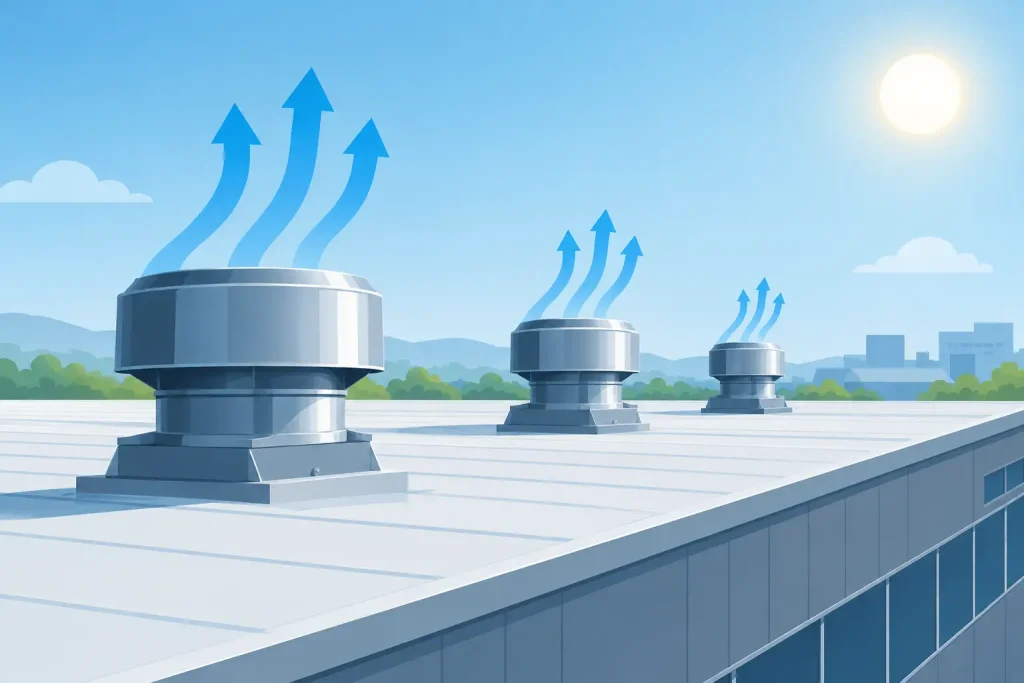
A factory roof can hold a surprising amount of heat long after the machinery has stopped. In warehouses, production halls and chemical-storage areas, that trapped heat can make working conditions harder, accelerate roof deterioration and allow fumes or moisture to remain where they should not. Industrial ventilation provides a practical route for moving hot, stale air out through the roof while replacement air enters through correctly planned intake points.
The right system is not chosen by roof area alone. Building height, internal heat sources, roof slope, extraction capacity, air inlet provision and the nature of the stored materials all affect the result. A ventilator that performs well on a general warehouse may not be the right choice for an oil and gas site or a chemical store.
What industrial ventilation must achieve
For most industrial buildings, roof ventilation has three jobs: remove accumulated heat, reduce airborne moisture and provide a controlled path for stale air to leave the building. Where processes create vapour, odours or non-hazardous fumes, extraction can also help keep these contaminants from lingering at roof level and drifting back into occupied work areas.
Heat removal is often the most visible benefit. Solar gain on a large metal roof, combined with process equipment, lighting and people, can create severe temperature build-up. Hot air naturally rises. A roof-mounted exhaust point uses that behaviour rather than fighting it, allowing the highest-temperature air to escape from the space where it collects.
Ventilation is not a substitute for local exhaust where a process produces hazardous dust, toxic gas or concentrated chemical vapour. Those risks require a properly engineered source-capture system, suitable ducting and site-specific safety controls. Roof ventilators can support the wider building airflow strategy, but they must not be treated as a single answer to every airborne hazard.
Start with the building, not the product
A reliable selection starts by looking at how the building behaves during its busiest and hottest periods. Measure the roof plan, ridge height and clear internal volume. Identify heat-producing machinery, loading bays, ovens, compressors, storage zones and areas where staff regularly work. Then establish where fresh air can enter.
Extraction without adequate intake air creates a common problem. The ventilator may be fitted correctly, but it has little air available to replace what it removes. This reduces airflow and can draw dust through unwanted gaps, doors or service openings. Aluminium air vents, wall louvres or planned low-level openings allow replacement air to enter more evenly and help establish an upward airflow path.
Roof layout also matters. A ventilator must suit the roof profile, pitch and covering, with correct flashing to protect against water ingress. Positioning near the highest practical roof point usually supports heat extraction, although equipment, structural members, skylights and prevailing wind exposure may affect the final arrangement. On long buildings, several correctly spaced units can perform better than concentrating capacity in one location.
Choosing between passive, turbine and solar extraction
There is no universal best ventilator. The appropriate operating method depends on the building use, required airflow consistency, available sunlight and safety requirements.
Passive updraft ventilators
Non-motorised updraft ventilators use the temperature and pressure difference between the building interior and outdoor air. As hot air rises, it exits through the ventilator, encouraging cooler replacement air to enter at lower level. They are especially suitable where there is a consistent internal heat load and a requirement for simple, continuous roof extraction.
Their major advantage is operating simplicity. No wiring, no TNB connection required, no motor and no routine electrical maintenance. For factories and warehouses that need dependable heat release without adding electrical infrastructure, this can make the whole-life cost easier to control.
Performance still depends on the available stack effect and intake-air design. In a cool building with limited heat gain, passive extraction will be less active than in a production area with a high roof temperature. Capacity should therefore be considered against actual operating conditions, not only a catalogue airflow figure.
Wind turbine ventilators
Wind turbine ventilators use wind energy to rotate the turbine head and create negative pressure that extracts air from below. They can be a practical choice for exposed roofs with regular wind movement and are widely used on workshops, warehouses and general factory buildings.
The trade-off is straightforward: output varies with wind speed. A well-sited turbine can provide useful extraction without electrical consumption, but calm conditions reduce wind-driven assistance. Turbine size, throat diameter, roof quantity and location should be selected together. One small unit cannot be expected to ventilate a large, heat-intensive production floor.
Material choice also deserves attention. Aluminium construction offers corrosion resistance and low weight for many roof applications. For aggressive coastal, chemical or high-corrosion environments, buyers should confirm the suitable material grade and all fixing details before installation.
Solar-powered roof ventilators
Solar-powered ventilators add powered extraction without relying on the building’s grid supply. When solar radiation is strongest, roof temperatures are often at their highest, making solar operation a logical match for daytime heat removal in commercial and industrial buildings.
They are useful where electrical cabling to the roof would be inconvenient, costly or undesirable. No wiring across the roof, no TNB connection required and no ongoing electricity consumption from the building supply. They can also suit remote structures and sites where a simple roof-mounted installation is preferred.
As with any solar equipment, output follows available sunlight. The correct approach is to assess daytime heat load, panel exposure and the need for overnight ventilation. Some buildings benefit from solar extraction as part of a wider passive ventilation layout rather than relying on a single operating method.
Ventilation for hazardous and sensitive locations
Oil and gas facilities, chemical warehouses and flammable-material stores demand a higher level of caution. In these environments, the priority is not merely cooling the roof space. The system must avoid introducing ignition risks while supporting the site’s wider hazardous-area design and operating procedures.
Passive roof ventilators can be particularly relevant where a non-electrical extraction method is required. No spark, no static current and no electrical connection at the ventilator itself are clear advantages when the application has been assessed as suitable. However, every hazardous location has its own classification, chemical exposure, temperature range and regulatory requirements. Product selection should be verified against the site specification and the advice of the responsible safety engineer.
Do not overlook corrosion. Chemical vapours, salt air and industrial emissions can shorten the life of unsuitable components. The housing, base, fasteners, mesh and flashing should all be considered as part of the installation, not as separate afterthoughts.
Capacity, quantity and installation quality
Airflow capacity is meaningful only when it is matched to the building. A large-capacity ventilator may be appropriate for a high-volume warehouse, while a group of smaller units may better serve a segmented roof or multiple heat zones. The aim is balanced extraction across the space, not simply the highest possible capacity at one roof point.
Before ordering, confirm the ventilator diameter, base dimensions, roof slope suitability, material, discharge opening and recommended installation arrangement. Contractors should inspect the roof structure and covering, provide compatible flashing and ensure every penetration is weatherproof. A poorly sealed base can turn a ventilation upgrade into a roof-leak problem.
Maintenance needs also differ by design. Non-motorised updraft units avoid motor servicing and electrical faults. Turbine units should be inspected for free rotation, debris and physical damage. Solar units need their panels kept clear enough to receive light, while all roof ventilators benefit from periodic checks after severe weather, nearby construction work or changes to the building process.
Forest Wind Corporation has manufactured roof ventilation systems since 1989, with options for residential roofs as well as factories, warehouses and demanding industrial facilities. The useful question is not simply which ventilator costs less at purchase. It is which operating method, capacity and material will continue to suit the roof, the process and the safety requirement over time.
A cooler roof starts with a clear path for air to enter low, rise through the building and leave at the highest practical point. Assess that path carefully before selecting equipment, and the ventilation system will have a far better chance of delivering the simple result every facility needs: safer, more workable air under the roof.