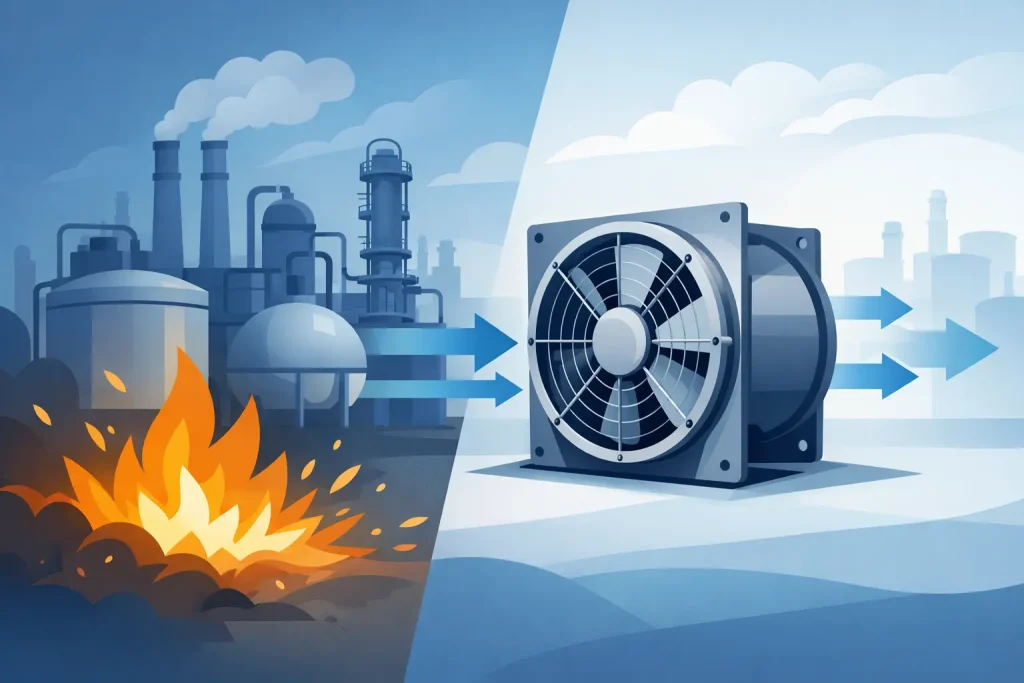
A roof ventilator installed above a chemical store or oil-handling area must do more than move hot air. If flammable vapours, gases or dust may be present, every electrical connection, motor, switching component and potential static-discharge point must be considered. Spark free ventilation for hazardous areas provides a practical route to heat and vapour extraction without adding unnecessary ignition sources at roof level.
For facilities managers, contractors and procurement teams, the decision is rarely just about airflow. The right system must suit the roof, the process risk, local weather exposure, required air-change rate and the site’s hazardous-area assessment. Passive ventilation is often a strong option because it removes the need for a roof-mounted electric motor, wiring and a TNB power connection.
Why hazardous areas need a different ventilation approach
Oil and gas sites, paint stores, chemical warehouses, battery rooms, solvent-handling facilities and certain manufacturing areas can contain atmospheres that become flammable under the wrong conditions. Vapours may accumulate when solvents are transferred, leaks occur, containers are opened or temperatures rise. Fine combustible dust can create similar concerns in processing and storage operations.
Mechanical extraction may be necessary in some applications, but an ordinary powered roof fan is not automatically suitable. Its motor, control gear, cable entry points and switching equipment require careful selection for the zone classification. Installation quality and ongoing inspection also matter. A poorly specified or poorly maintained electrical fan can introduce a risk that a passive roof ventilator avoids altogether.
A non-motorised updraft ventilator uses natural thermal lift. Hot air and lighter vapours rise, then discharge through the roof unit. A wind turbine ventilator adds wind-driven extraction, increasing airflow when outdoor wind is available. Neither system needs a roof-level motor or electrical wiring to operate.
That operating simplicity is valuable where access is difficult, downtime is costly or routine electrical maintenance is not desirable. No Wiring, No TNB Connection Required. For suitable applications, it also means no motor replacement programme and no electricity consumption during operation.
Selecting spark free ventilation for hazardous areas
The term “spark free” should not be treated as a broad label that overrides engineering controls. It describes the value of eliminating electrical drive components from the ventilation unit, but the complete installation still requires assessment. The process material, release source, gas or dust group, ventilation effectiveness and hazardous zone determine what is acceptable on site.
Start with the source of heat or vapour. A warehouse holding sealed chemical containers has different extraction requirements from a room where flammable liquids are decanted every day. Likewise, a naturally ventilated roof may be suitable for reducing general heat build-up, while a local extraction system may be required to capture vapour directly at a process point.
The ventilator must then be sized for the building volume, roof height, internal temperature, number of heat-generating machines and the expected vapour load. One small turbine on a large factory roof will not provide meaningful extraction. Industrial installations often require multiple units positioned to create a clear upward path for hot air, supported by adequate low-level intake vents.
Fresh-air entry is essential. An extractor cannot discharge air effectively if replacement air has no route into the building. Aluminium louvres, wall vents and low-level openings should be sized and located with the extraction points in mind. Poor intake provision can reduce airflow, pull contaminants through unsuitable areas or create uncomfortable draughts for personnel.
Passive updraft or wind turbine?
A non-motorised updraft ventilator is a dependable choice where heat rises consistently from the building and the owner wants no moving parts. It is well suited to large roofs, factories, warehouses and high-temperature internal spaces where stack effect can work throughout the day.
A wind turbine ventilator responds to outdoor wind and can deliver strong extraction when wind conditions are favourable. It is useful for workshops, warehouses and industrial roofs exposed to regular airflow. The trade-off is that performance changes with wind speed, while an updraft design depends more heavily on the temperature difference between inside and outside.
Neither option should be selected on appearance alone. Roof slope, opening size, flashing detail, prevailing wind, corrosion exposure and required capacity all affect the outcome. A specification based on roof area only can miss the real operating conditions.
Materials, static control and corrosion resistance
Material selection matters in hazardous environments. Aluminium construction is lightweight, corrosion resistant and suitable for many roof ventilation applications. Stainless steel may be preferred where chemicals, salt air or aggressive washdown conditions demand higher corrosion resistance. The correct choice depends on the vapours present and the roof environment, not simply the initial purchase price.
Static control requires equal attention. Passive operation removes the electrical motor and associated wiring, but it does not remove the need to consider bonding and earthing of conductive roof equipment where required by the site design. Components should be installed according to the facility’s electrical and process-safety requirements. This is particularly important where dust, solvents or hydrocarbon vapours are handled.
Avoid assumptions such as “metal cannot be used near flammables” or “any passive ventilator is automatically approved for every hazardous zone”. The safe answer depends on the documented area classification and the complete roof installation. A competent hazardous-area engineer or the site safety team should confirm the specification before procurement.
Installation details that affect performance
A high-capacity ventilator cannot compensate for a badly prepared roof opening. The opening must match the unit throat size and be properly weathered to prevent water ingress. On industrial metal roofs, installers should check sheet profile, purlin positions, insulation build-up and the strength of the surrounding roof structure before cutting.
Positioning is equally important. Extractors should normally sit near the highest practical roof level, where heat naturally collects. They should not be placed immediately beside fresh-air intakes, discharge stacks or building openings that could allow extracted vapours to re-enter occupied areas. For a larger roof, evenly distributed units usually perform better than concentrating all extraction in one corner.
Weather protection must not obstruct airflow. Correct flashing, secure fasteners and a well-finished roof penetration protect the building while allowing the ventilator to perform at its stated capacity. On coastal sites or exposed industrial estates, specify materials and fixings that can withstand long-term wind and corrosion exposure.
Do not use ventilation as the only safety control
Ventilation helps dilute and remove heat, vapours and stale air. It does not make a hazardous process safe by itself. Where flammable materials are present, facilities still need suitable containment, housekeeping, leak management, ignition control, gas detection where required, emergency procedures and trained personnel.
This distinction is important when specifying passive systems. Natural extraction can offer reliable day-to-day ventilation with no electrical consumption, but its airflow varies with thermal conditions and, for turbine units, wind. If a process demands guaranteed extraction at a defined rate under all conditions, engineered mechanical ventilation with suitably rated equipment may be required. In some buildings, passive roof ventilation and controlled mechanical extraction work together, each serving a different purpose.
A practical specification route
Before requesting a quotation, gather the roof plan, roof slope, building dimensions, required opening sizes and information about the process environment. Identify whether the goal is general heat removal, vapour dilution, moisture control or support for a wider hazardous-area ventilation strategy. Include the material preference, expected corrosion exposure and any site-specific safety requirements.
Forest Wind has manufactured roof ventilation systems since 1989 for applications ranging from residential roofs to factories, warehouses and demanding industrial facilities. For hazardous locations, the most useful quotation is one based on the actual roof and duty, rather than a generic fan size.
A well-specified passive roof ventilator can reduce roof-space heat and support safer air movement without motors, wiring or ongoing power costs. The right next step is to match the ventilator capacity and material to the site assessment, then install it as part of a complete, properly managed safety system.