A roof space can become the hottest part of a building long before occupants feel the effect below. In a home, that heat can make upper rooms uncomfortable and place extra load on cooling. In a factory or warehouse, trapped hot air can affect staff comfort, stored goods and working conditions. Roof ventilation without electricity offers a direct answer: remove rising heat, moisture and stale air without relying on mains wiring, motors or ongoing electricity charges.
The right system is not simply the one with the largest ventilator. It must suit the roof area, internal heat load, roof slope, available air inlets and the building’s safety requirements. A passive ventilator can be an excellent long-term solution where natural buoyancy is strong. A wind turbine can increase extraction when wind is available. A solar attic ventilator adds powered airflow during sunny hours without a grid connection.
How roof ventilation without electricity removes heat
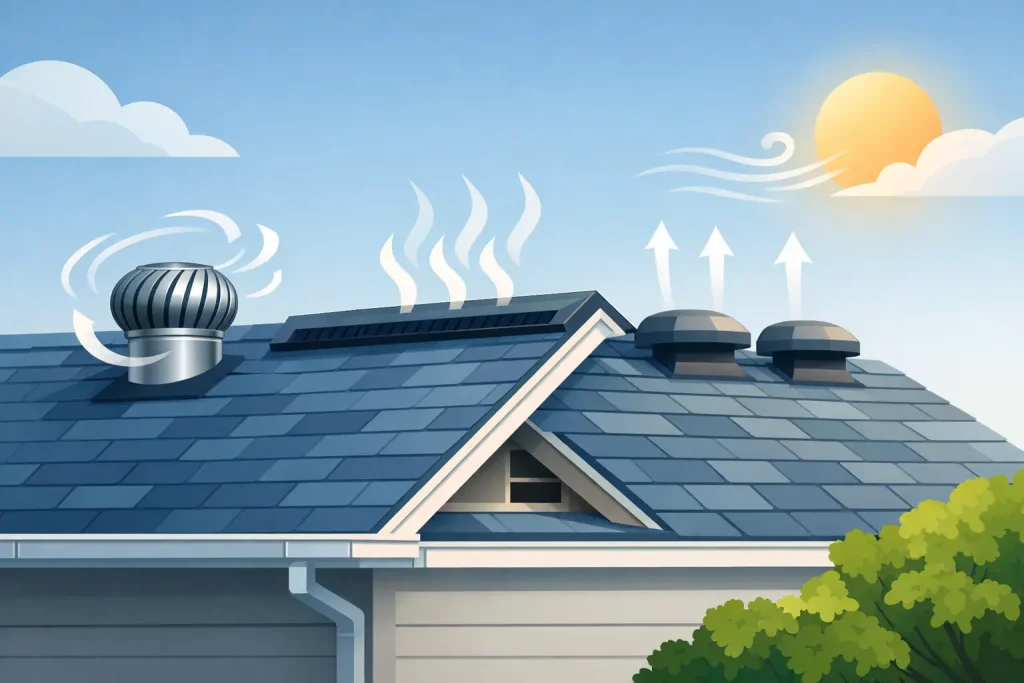
Hot air rises. In a roof void, warehouse roof or factory ceiling space, solar gain and internal processes warm the air until it collects at the highest point. A roof ventilator creates a high-level escape route, allowing that hot air to leave. Replacement air then enters through lower-level vents, eaves, louvers or other designed intake points.
This is the principle behind passive updraft ventilation. It has no motor, no wiring and no moving parts. Where there is a reliable temperature difference between the inside and outside air, the stack effect helps move air upwards and out through the roof.
Wind-assisted turbine ventilators use the same high-level position but add rotation created by wind. The rotating turbine creates a low-pressure area that assists air extraction. They are useful on exposed roofs, warehouses and workshops where air changes are needed across a large floor area.
Solar ventilators use sunlight to power a fan directly. They do not require a mains connection or a separate electrical circuit. When solar radiation is strongest, roof temperatures are often at their highest, making this operating pattern particularly suitable for residential attic spaces, top-floor rooms and smaller commercial roofs.
No wiring. No mains electricity connection. Lower operating cost. However, every method depends on correct system design.
The three main system choices
Passive updraft ventilators
A non-motorised updraft ventilator is designed for continuous natural extraction. It is often the preferred choice where reliability, simple operation and zero electrical dependence are the main priorities. With no electrical components and no moving parts, it is well suited to roofs that need long service life with minimal routine attention.
Passive units are effective for homes, factories, warehouses, agricultural buildings and covered work areas, provided there is a path for replacement air to enter. Installing roof extractors without sufficient intake ventilation can limit performance. Air cannot leave a sealed building unless air can also come in.
Material selection matters. Aluminium offers low weight and good corrosion resistance for many roof environments. More demanding industrial sites may require heavier-duty material choices or site-specific specification, especially where fumes, salt exposure or chemical contamination are present.
Wind turbine ventilators
Wind turbine ventilators are a familiar option for broad industrial and commercial roofs. Their rotating heads respond to wind and can support air extraction even when indoor heat levels are moderate. They are commonly selected for factories, workshops, warehouses and production areas where a number of units can be distributed along the roof ridge.
Their output varies with wind conditions, so they should not be specified on wind alone. They also benefit from thermal lift created by hot air below the roof. A well-planned turbine layout considers the building length, roof profile, obstructions, prevailing wind direction and required ventilation capacity.
Turbines contain moving components, unlike passive updraft units. Quality construction, correct installation and periodic inspection remain sensible, particularly on large roofs exposed to weather over many years.
Solar attic ventilators
Solar attic ventilators are best where a defined roof space needs stronger daytime extraction than passive airflow alone can provide. The photovoltaic panel powers the fan during daylight, removing accumulated attic heat without increasing electricity consumption.
For homeowners, this can improve conditions in roof voids beneath sun-exposed tiles or metal roofing. For small commercial buildings, guard houses and site offices, solar ventilation can offer an independent solution where electrical wiring to the roof would be inconvenient or costly.
A solar fan is not a replacement for every industrial ventilation requirement. Its capacity, panel orientation and daylight availability must match the application. Large factories with high internal heat gain may require multiple industrial ventilators or a passive and wind-assisted design across the full roof area.
Sizing the system for the building, not the brochure
Ventilation capacity must be matched to the air volume and heat source. A small attic, a long warehouse and a chemical storage building do not have the same airflow requirement. Selecting a ventilator only by throat diameter can lead to poor results.
Start with the building’s dimensions, roof height and roof shape. Then consider whether the heat is coming mainly from solar exposure, machinery, processes, stored products or occupancy. A warehouse with a high metal roof may need extraction points spaced across a wide area. A house may need a smaller number of correctly placed ventilators combined with clear eaves ventilation.
The following information helps specify a suitable system:
- Roof length, width, ridge height and total internal volume.
- Roof material, pitch, structural condition and available installation position.
- Existing intake vents, louvers, doors or other replacement-air paths.
- Sources of heat, moisture, fumes, dust or vapour within the building.
- Local weather exposure, including sunlight, rainfall, wind and corrosive conditions.
For contractors, these details also determine flashing requirements and mounting method. A ventilator must be properly weathered into the roof covering, not simply fixed through it. Correct installation protects both ventilation performance and roof integrity.
Moisture control needs a balanced approach
Heat is the most visible problem under a roof, but moisture can be more damaging over time. Condensation in roof spaces can contribute to mould, timber deterioration, corrosion and damp insulation. Passive roof extraction can help remove humid air, but it should be part of a wider moisture-control plan.
Leaks, unsealed service penetrations and wet internal processes should be addressed at source. In very cold conditions, uncontrolled ventilation can also increase heat loss if the roof assembly and ceiling air barrier are poorly detailed. The aim is controlled airflow through the roof void, not random draughts through the occupied space below.
For buildings that store chemicals, fuels or volatile materials, ventilation design must be assessed against the specific hazard. Passive systems avoid electrical motors and wiring at roof level, reducing potential electrical ignition sources. Yet no ventilator alone makes a hazardous area safe. Site classification, vapour behaviour, extraction requirements and local safety rules must guide the final selection.
Installation details that determine performance
The highest practical roof position is usually the best place for an extractor because heat and humid air collect there. On long industrial buildings, several ventilators may be needed rather than one oversized unit at a single point. Spacing improves coverage and reduces stagnant hot zones.
Low-level air entry is equally important. Eaves vents, wall louvers or purpose-designed aluminium air vents provide the route for fresh air to replace extracted air. If the building has mechanical exhaust equipment elsewhere, its effect on pressure balance should also be considered.
Roof slope compatibility should be confirmed before ordering. Flashing and base design must match the roof profile, whether the covering is metal deck, tiles or another system. For coastal, industrial or chemical environments, specify materials that can withstand the expected exposure rather than choosing solely on initial price.
Forest Wind has manufactured roof ventilation systems since 1989, supplying solar-powered, turbine and non-motorised options for residential roofs through to large industrial facilities. The practical next step is to prepare the roof dimensions, application details and site conditions before requesting a capacity and configuration recommendation.
A roof ventilator earns its value quietly: it removes heat at the point where heat gathers, supports healthier airflow and does so without adding another mains-powered load. Choose the operating method around the building, then give the system the intake air, placement and installation quality it needs to perform.
Pingback: Spark Free Ventilation for Hazardous Areas – Forest Wind Profile
Pingback: Spark Free Ventilation for Hazardous Areas – Forest Wind Profile
Pingback: Roof Ventilation for Chemical Storage Sites – Forest Wind Profile
Pingback: Stainless Steel Roof Ventilator Corrosion Causes – Forest Wind Profile
Pingback: Powder Coated Aluminium Air Vents That Last – Forest Wind Profile