
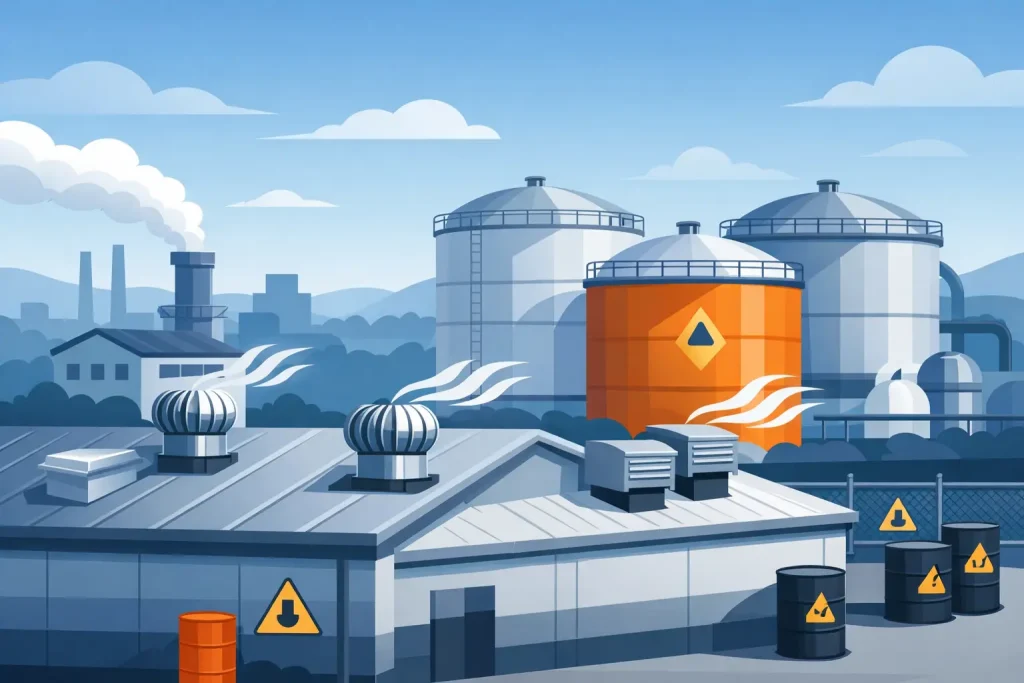
Roof Ventilation for Chemical Storage Sites

Roof Ventilation for Chemical Storage Sites

A chemical store can appear quiet while heat and vapours build above the working zone. That is why roof ventilation for chemical storage must be treated as a safety and containment decision, not simply a way to cool the building. The correct system helps remove accumulated heat and airborne vapours, supports a safer working environment and reduces strain on the roof space without introducing an avoidable ignition source.

For facilities managers, contractors and procurement teams, the right answer depends on the chemicals present, the room layout, the storage method and the applicable hazardous-area requirements. A ventilator should never be selected by roof area alone.

Why chemical storage needs planned roof ventilation

Many stored chemicals release vapours as temperatures rise, during decanting, after small spills or when containers are opened. Some vapours are heavier than air and settle at low level. Others can rise, mix with warm air and collect under the roof. Heat can also affect product stability, packaging condition and internal pressure in certain containers.

Natural and passive roof extraction can remove hot air that gathers at high level. This helps maintain air movement through the building when it is paired with correctly designed low-level or sidewall air inlets. Fresh replacement air is essential. Without it, an extractor cannot deliver its intended airflow, and the building may simply draw air through unintended gaps.

Ventilation is only one control measure. It does not replace safe segregation, spill containment, closed handling procedures, gas detection, local extraction at transfer points or the advice in each chemical safety data sheet. It must form part of the site risk assessment and the wider fire and explosion safety strategy.

Roof ventilation for chemical storage: start with the hazard

Before selecting a roof ventilator, identify what is being stored and how the space is used. A warehouse holding sealed, non-flammable cleaning products has a different requirement from a room used for flammable solvents, corrosive liquids, oxidisers or gases. The most demanding condition should guide the design, rather than average day-to-day activity.

Review the quantity stored, packaging type, container venting arrangements, likely vapour release points and expected internal temperature. Consider whether chemical handling occurs in the same area as storage. Decanting, mixing, charging and waste handling can create short periods of much higher vapour concentration than static storage.

The physical behaviour of the vapour matters. High-level roof ventilation is often useful for heat and lighter vapours, but it may not control heavier-than-air vapours near the floor. In those cases, low-level extraction or a dedicated local system may be required alongside roof ventilation. A competent hazardous-area and ventilation specialist should determine the airflow path, extraction level and required duty.

Where flammable atmospheres may occur, equipment selection must follow the relevant area classification and local regulations. Do not assume that a standard powered roof fan is suitable. Its motor, switching equipment, wiring and rotating components may introduce risks that need formal assessment.

Passive and turbine ventilation for hazardous roofs

For many industrial roofs, passive updraft ventilators and wind turbine ventilators offer a practical route to continuous high-level heat extraction. They work without a grid electrical connection, motors or routine electrical wiring at roof level. This removes several maintenance and ignition-related considerations associated with conventional powered extraction.

A non-motorised updraft ventilator uses the natural rise of hot air to encourage extraction. It is particularly suited to buildings where process heat, solar gain and warm roof-level air create a sustained stack effect. Wind turbine ventilators use wind energy to increase extraction and can provide useful airflow across large factory and warehouse roofs.

The benefit is operational simplicity: no TNB connection required, no motor replacement programme and no electrical sparking from a roof-mounted drive system. For chemical-storage environments, this can be a valuable design advantage, but it does not automatically make every passive unit suitable for every hazardous location. The complete installation, including air inlets, ductwork where used, roof penetrations and nearby activities, still requires site-specific review.

Solar-powered ventilators can be effective for general heat removal in suitable non-hazardous roof spaces. However, a solar unit includes electrical components and should not be assumed suitable where a flammable gas or vapour atmosphere could be present. The hazardous-area classification must come first.

Size the system around airflow, not assumptions

A roof ventilator’s throat size, free area and extraction capacity determine what it can contribute to the building. Larger industrial units can move substantially more warm air, but capacity figures should be considered alongside the number of units, roof layout, prevailing wind, building height and available make-up air.

A practical design examines the full air route. Air should enter from a controlled location, travel through the storage zone and leave at the intended high-level outlet. If incoming air is blocked by racking, enclosed rooms or tightly packed pallets, the roof units may ventilate only the upper void while stagnant pockets remain below.

Roof slope also affects selection and installation. The ventilator base and flashing must suit the roof profile, whether metal deck, corrugated sheeting or another roofing system. Poorly formed flashings can cause leaks, corrosion and premature roof damage, particularly on industrial sites exposed to heavy rain and strong wind.

For large stores, a layout drawing is more useful than a single capacity figure. It should show chemical zones, doors, louvres, roof ventilators, obstructions, transfer areas and any existing mechanical extraction. This allows the designer to avoid placing units where they short-circuit airflow from a nearby inlet or leave remote bays under-ventilated.

Materials and construction matter

Chemical storage roofs can be exposed to humid air, corrosive vapours, airborne dust and coastal weather. Material selection should reflect the environment. Aluminium roof vents can be a suitable lightweight and corrosion-resistant option in many applications, while other materials or protective finishes may be needed where the chemical atmosphere is particularly aggressive.

Ask for clear information on ventilator dimensions, material thickness, weather protection, fixing method and recommended roof opening. Industrial buyers should also confirm resistance to wind loading and the suitability of seals, fasteners and flashings for the roof and atmosphere involved.

Internal surfaces deserve attention as well. Deposits can reduce free airflow over time, and corroded mesh, bird guards or dampers can restrict performance. Where contamination is likely, specify a design that can be inspected safely from the roof or internal access point.

Installation and maintenance controls

Even a passive roof ventilator needs proper installation and inspection. Confirm that the roof structure can support the unit and any required kerb, and that the installation does not compromise fire-rated elements or drainage paths. Work at height controls, roof access and future inspection arrangements should be agreed before work begins.

After installation, check that intended inlets are open, louvres operate correctly where fitted and airflow is not being obstructed by stored materials. Changes in racking, partition walls or stock volumes can alter ventilation performance without anyone noticing.

A simple maintenance plan should cover visual checks for loose fixings, damaged flashings, blocked openings, corrosion, water ingress and debris. In chemical areas, inspection frequency should reflect the site atmosphere and the consequences of reduced extraction. If odours increase, condensation appears, temperatures rise or gas detection alarms occur, investigate the root cause rather than relying on additional roof units as a quick fix.

Forest Wind has manufactured roof ventilation systems since 1989, with passive updraft and wind turbine options suited to demanding factory, warehouse and industrial roof applications. The right product choice should be based on the roof, the required airflow and the risk assessment for the stored substances.

Specify the right solution before ordering

When requesting a quotation, provide the roof type and slope, building dimensions, ridge height, available inlet locations, internal heat sources and the chemicals being stored. State whether the site has a classified hazardous area, whether handling takes place inside and whether there are existing extraction or detection systems. These details allow a supplier and project team to recommend unit size, quantity, materials and installation arrangement with fewer assumptions.

A well-specified roof ventilation system should work quietly in the background: removing roof-level heat, supporting planned airflow and avoiding unnecessary electrical dependence. Start with the chemical hazard, then design the roof ventilation around the way the building actually operates.

2 thoughts on “Roof Ventilation for Chemical Storage Sites”

  1. Pingback: Is a Roof Ventilator Fan Solar Right for You? – Forest Wind Profile

  2. Pingback: Passive Versus Powered Extraction for Roofs – Forest Wind Profile

Leave a Comment

Your email address will not be published. Required fields are marked *

Roof Ventilation for Chemical Storage Sites

Roof Ventilation for Chemical Storage Sites

A chemical store can appear quiet while heat and vapours build above the working zone. That is why roof ventilation for chemical storage must be treated as a safety and containment decision, not simply a way to cool the building. The correct system helps remove accumulated heat and airborne vapours, supports a safer working environment and reduces strain on the roof space without introducing an avoidable ignition source.

For facilities managers, contractors and procurement teams, the right answer depends on the chemicals present, the room layout, the storage method and the applicable hazardous-area requirements. A ventilator should never be selected by roof area alone.

Why chemical storage needs planned roof ventilation

Many stored chemicals release vapours as temperatures rise, during decanting, after small spills or when containers are opened. Some vapours are heavier than air and settle at low level. Others can rise, mix with warm air and collect under the roof. Heat can also affect product stability, packaging condition and internal pressure in certain containers.

Natural and passive roof extraction can remove hot air that gathers at high level. This helps maintain air movement through the building when it is paired with correctly designed low-level or sidewall air inlets. Fresh replacement air is essential. Without it, an extractor cannot deliver its intended airflow, and the building may simply draw air through unintended gaps.

Ventilation is only one control measure. It does not replace safe segregation, spill containment, closed handling procedures, gas detection, local extraction at transfer points or the advice in each chemical safety data sheet. It must form part of the site risk assessment and the wider fire and explosion safety strategy.

Roof ventilation for chemical storage: start with the hazard

Before selecting a roof ventilator, identify what is being stored and how the space is used. A warehouse holding sealed, non-flammable cleaning products has a different requirement from a room used for flammable solvents, corrosive liquids, oxidisers or gases. The most demanding condition should guide the design, rather than average day-to-day activity.

Review the quantity stored, packaging type, container venting arrangements, likely vapour release points and expected internal temperature. Consider whether chemical handling occurs in the same area as storage. Decanting, mixing, charging and waste handling can create short periods of much higher vapour concentration than static storage.

The physical behaviour of the vapour matters. High-level roof ventilation is often useful for heat and lighter vapours, but it may not control heavier-than-air vapours near the floor. In those cases, low-level extraction or a dedicated local system may be required alongside roof ventilation. A competent hazardous-area and ventilation specialist should determine the airflow path, extraction level and required duty.

Where flammable atmospheres may occur, equipment selection must follow the relevant area classification and local regulations. Do not assume that a standard powered roof fan is suitable. Its motor, switching equipment, wiring and rotating components may introduce risks that need formal assessment.

Passive and turbine ventilation for hazardous roofs

For many industrial roofs, passive updraft ventilators and wind turbine ventilators offer a practical route to continuous high-level heat extraction. They work without a grid electrical connection, motors or routine electrical wiring at roof level. This removes several maintenance and ignition-related considerations associated with conventional powered extraction.

A non-motorised updraft ventilator uses the natural rise of hot air to encourage extraction. It is particularly suited to buildings where process heat, solar gain and warm roof-level air create a sustained stack effect. Wind turbine ventilators use wind energy to increase extraction and can provide useful airflow across large factory and warehouse roofs.

The benefit is operational simplicity: no TNB connection required, no motor replacement programme and no electrical sparking from a roof-mounted drive system. For chemical-storage environments, this can be a valuable design advantage, but it does not automatically make every passive unit suitable for every hazardous location. The complete installation, including air inlets, ductwork where used, roof penetrations and nearby activities, still requires site-specific review.

Solar-powered ventilators can be effective for general heat removal in suitable non-hazardous roof spaces. However, a solar unit includes electrical components and should not be assumed suitable where a flammable gas or vapour atmosphere could be present. The hazardous-area classification must come first.

Size the system around airflow, not assumptions

A roof ventilator’s throat size, free area and extraction capacity determine what it can contribute to the building. Larger industrial units can move substantially more warm air, but capacity figures should be considered alongside the number of units, roof layout, prevailing wind, building height and available make-up air.

A practical design examines the full air route. Air should enter from a controlled location, travel through the storage zone and leave at the intended high-level outlet. If incoming air is blocked by racking, enclosed rooms or tightly packed pallets, the roof units may ventilate only the upper void while stagnant pockets remain below.

Roof slope also affects selection and installation. The ventilator base and flashing must suit the roof profile, whether metal deck, corrugated sheeting or another roofing system. Poorly formed flashings can cause leaks, corrosion and premature roof damage, particularly on industrial sites exposed to heavy rain and strong wind.

For large stores, a layout drawing is more useful than a single capacity figure. It should show chemical zones, doors, louvres, roof ventilators, obstructions, transfer areas and any existing mechanical extraction. This allows the designer to avoid placing units where they short-circuit airflow from a nearby inlet or leave remote bays under-ventilated.

Materials and construction matter

Chemical storage roofs can be exposed to humid air, corrosive vapours, airborne dust and coastal weather. Material selection should reflect the environment. Aluminium roof vents can be a suitable lightweight and corrosion-resistant option in many applications, while other materials or protective finishes may be needed where the chemical atmosphere is particularly aggressive.

Ask for clear information on ventilator dimensions, material thickness, weather protection, fixing method and recommended roof opening. Industrial buyers should also confirm resistance to wind loading and the suitability of seals, fasteners and flashings for the roof and atmosphere involved.

Internal surfaces deserve attention as well. Deposits can reduce free airflow over time, and corroded mesh, bird guards or dampers can restrict performance. Where contamination is likely, specify a design that can be inspected safely from the roof or internal access point.

Installation and maintenance controls

Even a passive roof ventilator needs proper installation and inspection. Confirm that the roof structure can support the unit and any required kerb, and that the installation does not compromise fire-rated elements or drainage paths. Work at height controls, roof access and future inspection arrangements should be agreed before work begins.

After installation, check that intended inlets are open, louvres operate correctly where fitted and airflow is not being obstructed by stored materials. Changes in racking, partition walls or stock volumes can alter ventilation performance without anyone noticing.

A simple maintenance plan should cover visual checks for loose fixings, damaged flashings, blocked openings, corrosion, water ingress and debris. In chemical areas, inspection frequency should reflect the site atmosphere and the consequences of reduced extraction. If odours increase, condensation appears, temperatures rise or gas detection alarms occur, investigate the root cause rather than relying on additional roof units as a quick fix.

Forest Wind has manufactured roof ventilation systems since 1989, with passive updraft and wind turbine options suited to demanding factory, warehouse and industrial roof applications. The right product choice should be based on the roof, the required airflow and the risk assessment for the stored substances.

Specify the right solution before ordering

When requesting a quotation, provide the roof type and slope, building dimensions, ridge height, available inlet locations, internal heat sources and the chemicals being stored. State whether the site has a classified hazardous area, whether handling takes place inside and whether there are existing extraction or detection systems. These details allow a supplier and project team to recommend unit size, quantity, materials and installation arrangement with fewer assumptions.

A well-specified roof ventilation system should work quietly in the background: removing roof-level heat, supporting planned airflow and avoiding unnecessary electrical dependence. Start with the chemical hazard, then design the roof ventilation around the way the building actually operates.

Leave a Comment

Your email address will not be published. Required fields are marked *