
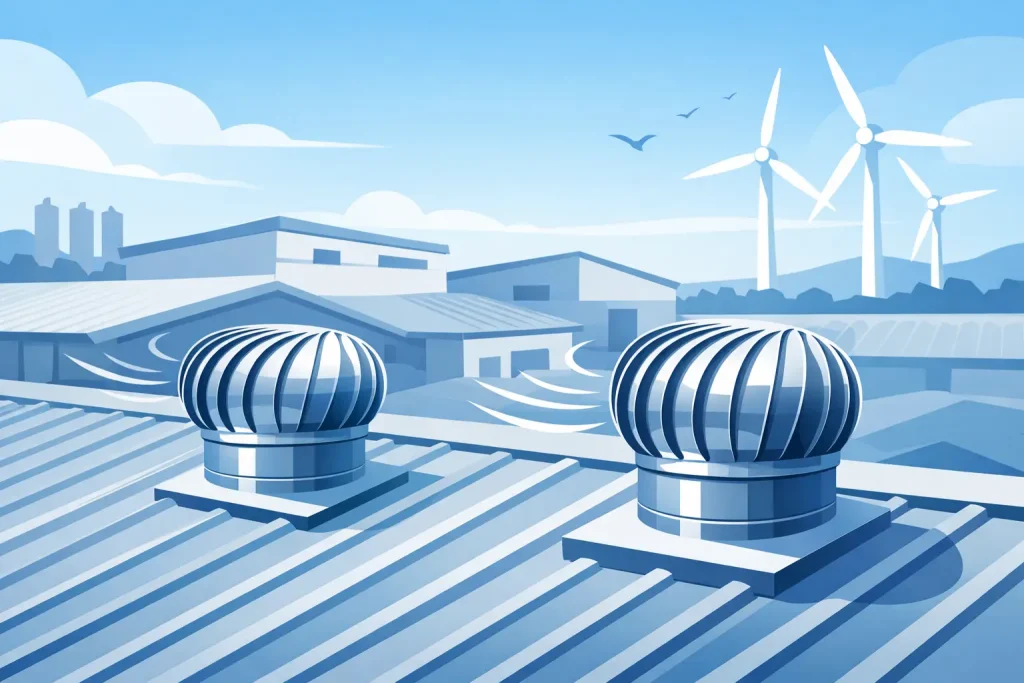
A warehouse roof can trap heat long after the outdoor temperature has fallen. Solar gain, forklifts, lighting, machinery and warm stock all add to the load, while hot air naturally collects at the highest point of the building. A correctly specified wind turbine ventilator for warehouse use gives that heat a route out through the roof, using natural wind and thermal updraught rather than electrical power.
For warehouse owners and facilities managers, the benefit is practical: less stagnant air beneath the roof, a more manageable indoor environment and no dependence on wiring, motors or a TNB connection. The correct unit is not simply the largest turbine available. Roof area, internal heat load, roof profile, local wind exposure and the type of goods stored must all be considered before selecting the ventilator size and quantity.
Why warehouse roofs need continuous heat extraction
Hot air rises, but it cannot leave a sealed building efficiently. Without high-level exhaust ventilation, heat remains beneath the roof sheeting and radiates back into the space below. This can make picking areas uncomfortable, increase strain on cooling equipment and create condensation risks when warm, moisture-laden air meets cooler roof surfaces.
A wind turbine ventilator rotates when wind passes over its fins. This creates a low-pressure area that draws hot air upward from the warehouse. Even in light wind conditions, the temperature difference between the indoor air and the air above the roof can support natural updraught. The result is passive extraction throughout the day without electricity consumption.
This approach is particularly suitable for high-roof warehouses, distribution buildings, workshops and factories where heat gathers well above the work floor. It is also useful where electrical installation at roof level would be costly, difficult or unsuitable.
Choosing a wind turbine ventilator for warehouse capacity
Capacity starts with the roof opening, often described by the turbine throat diameter. A larger throat allows a greater volume of air to be extracted, provided the warehouse has sufficient replacement air entering at lower level. Installing turbines without considering air intake can limit performance. Air must be able to enter through louvres, wall vents, doors or purpose-designed aluminium air vents as hot air exits through the roof.
A small warehouse with modest heat gain may need only a limited number of standard turbine ventilators. A large logistics building, production warehouse or metal-roofed factory may require larger industrial units positioned across the roof ridge or upper roof area. The aim is even extraction, not concentrating all ventilation at one end of the building.
When reviewing a quotation, provide the building length, width, ridge height, roof type and approximate roof slope. It also helps to state whether there are heat-producing processes, enclosed loading areas, high-bay racking, forklifts or regularly open roller shutters. These details affect the required airflow pattern and the number of roof ventilators.
Size alone does not determine performance
A large turbine may be appropriate for a large roof, but capacity also depends on placement and site conditions. Turbines installed close to obstructions, taller adjoining buildings or parapet walls can receive less consistent wind. In very sheltered locations, passive updraught ventilation may still work, but the expected extraction rate should be assessed realistically.
Roof layout matters as well. Long warehouse roofs often benefit from multiple ventilators spread across the upper roof zone. This reduces pockets of trapped heat and supports a more balanced movement of air. A facility with separate internal bays or partitions may also need ventilation planned by zone rather than calculated only from total floor area.
Material selection for roof and operating conditions
Warehouse ventilation equipment remains exposed to rain, ultraviolet light, airborne dust and changing temperatures. Material choice should match the roof environment, not just the initial purchase price.
Aluminium turbine ventilators are commonly selected for their light weight, corrosion resistance and suitability for general warehouse roofs. They are a practical option for many industrial and commercial applications. Stainless steel may be considered where the atmosphere is more corrosive or where higher material resistance is required. Galvanised finishes can also suit specified applications, depending on roof conditions and maintenance planning.
For coastal sites, chemical storage areas and buildings exposed to corrosive fumes, material selection requires additional care. The ventilator, flashing and roof fasteners must be compatible. A strong turbine body is not enough if surrounding components deteriorate faster than the unit itself.
Forest Wind provides roof ventilation systems in different material and size configurations, allowing buyers to match the unit to the building rather than forcing a standard residential solution onto an industrial roof.
Installation details that affect warehouse ventilation
A turbine ventilator should be installed at the high point of the roof where accumulated heat can rise directly towards it. On pitched roofs, this is typically near the ridge. The base flashing must suit the roof profile, whether the building uses metal decking, corrugated sheets or another roofing system. Poor flashing work can cause leaks even when the ventilator itself is well made.
Roof slope compatibility must be confirmed before installation. The turbine base needs to sit correctly, remain weather-tight and support the upright alignment needed for efficient rotation. An incorrectly tilted turbine can affect drainage and operating performance.
It is also sensible to consider safe roof access. Although a wind turbine ventilator has no motor, wiring or electrical control system, periodic visual inspection remains good facility practice. Check for debris, damaged flashing, loose fasteners and unusual movement after severe weather. This is a straightforward inspection, not a motor maintenance programme.
Plan the intake path before fitting roof exhausts
Every extraction system needs make-up air. If a warehouse is tightly enclosed, turbines may create insufficient airflow because replacement air cannot enter freely. Lower-level wall vents, intake louvres and appropriate door openings allow fresh air to replace the rising warm air.
The intake position should support the work area without creating an unpleasant draught directly across staff stations. For warehouses handling dust, fumes or odours, air should be drawn from a clean source rather than from loading bays, vehicle routes or neighbouring processes. This is where ventilation design becomes more than a roof product decision.
When passive turbine ventilation is the right choice
Wind turbine ventilation is a strong fit where the goal is continuous roof-level heat extraction without electrical running costs. No wiring, no motor and no TNB connection required. It can reduce reliance on electrically powered extraction for general heat removal and works well on warehouses with a clear path for air to rise and exit.
It is not a replacement for every ventilation requirement. Where a warehouse contains concentrated process fumes, welding smoke, chemical vapours or combustible gases, the system may require dedicated local exhaust, ducting and professional hazard assessment. General roof extraction should not be treated as a substitute for source capture where workers are exposed to hazardous contaminants.
For oil and gas facilities and chemical-storage environments, electrical equipment can introduce concerns around sparks and static current. Passive and non-motorised roof ventilation may offer a useful safety advantage in suitable areas because there is no electrical drive at the ventilator. However, site classification, process risk and required compliance measures must always govern the final equipment selection.
Comparing turbines with solar and non-motorised updraught ventilators
A wind turbine uses external wind and thermal movement. It is a dependable passive choice for many warehouses, particularly where natural wind exposure is good and a rotating turbine is acceptable.
A non-motorised updraught ventilator uses the natural rise of hot air without relying on turbine rotation. This can suit sites seeking a static roof ventilator design or installations where a fixed unit better matches the application. Solar-powered ventilators add active extraction when sunlight is available and can be useful where more controlled airflow is required without grid electricity.
The best choice depends on the building. A naturally ventilated storage warehouse may suit turbine ventilation. A hotter factory roof may benefit from a combined strategy using passive intake, turbine or updraught extraction, and solar-powered units in selected areas. The right answer comes from the heat source, roof design, operating hours and required level of airflow.
What to prepare before requesting a quotation
A useful quotation begins with accurate site information. Share the roof plan or basic building dimensions, roof material, slope, ridge height and photographs of the installation area. Identify whether the warehouse stores ordinary dry goods, food products, temperature-sensitive stock, chemicals or flammable materials. State any internal heat sources and whether lower-level air vents already exist.
This allows the supplier to recommend a suitable turbine diameter, material, base arrangement and quantity. It also prevents a common mistake: buying roof exhaust capacity without providing adequate intake ventilation below.
A warehouse ventilation system should make daily operations easier, not add another electrical asset to manage. Select roof ventilators around the building’s real heat load and air path, install them with weather-tight flashing, and give hot air a dependable route out of the roof.