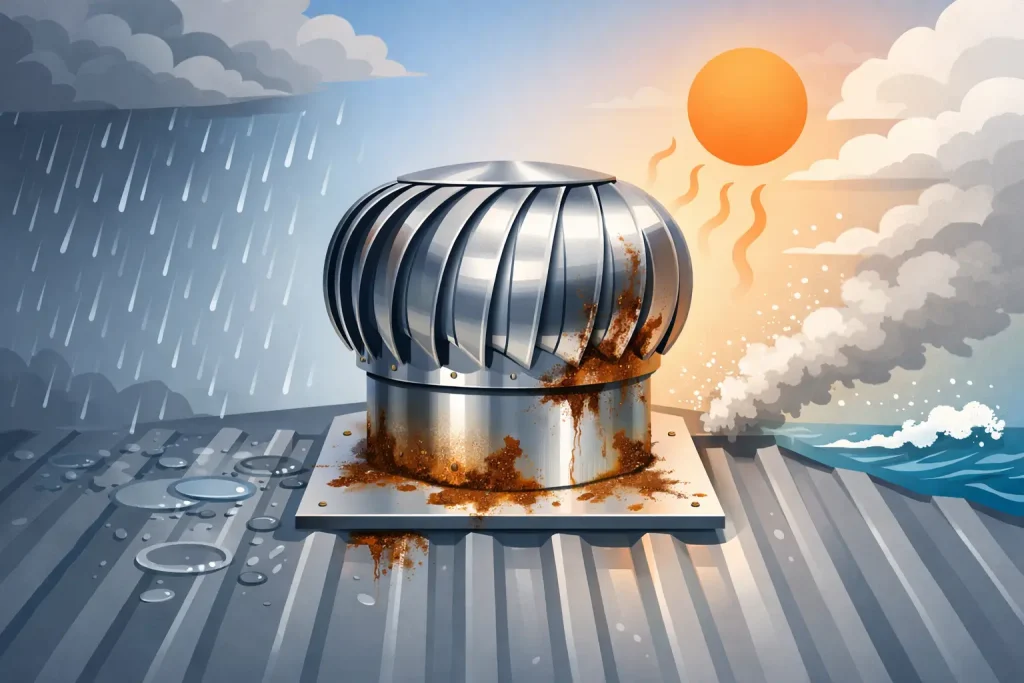
A stainless steel roof ventilator can look sound from ground level while salt deposits, trapped water or incompatible fixings are already attacking its surface. Stainless steel roof ventilator corrosion is not usually caused by the material simply being poor quality. More often, it starts when the selected grade, roof environment and installation method do not match.
For homeowners, the result may be tea-coloured staining around a turbine ventilator or flashing. For factories, warehouses and chemical-storage buildings, corrosion can become a larger operational issue: reduced service life, water ingress, contaminated exhaust paths and avoidable roof maintenance. The practical question is not whether stainless steel can corrode. It can. The question is whether the ventilator has been specified and installed for the conditions it will actually face.
Why Stainless Steel Roof Ventilator Corrosion Occurs
Stainless steel resists corrosion because chromium in the metal forms a thin, protective passive layer on the surface. When that layer is exposed to oxygen, it can repair itself. This is why stainless steel performs well on many roofs without paint or frequent maintenance.
However, that protection has limits. Chlorides from sea air, cleaning chemicals, industrial emissions and standing contaminated water can break down the passive layer. A roof ventilator is particularly exposed because it sits above the roof line, catches wind-driven rain and may retain dust or salt around seams, fasteners and the base flange.
Not every brown mark means the stainless steel itself is failing. Carbon-steel grinding dust, drilling swarf, rusty screws or nearby metalwork can contaminate the surface and leave rust stains. This is known as surface contamination. It should still be cleaned promptly, because deposits can hold moisture against the ventilator and eventually create localised corrosion.
True corrosion needs a closer inspection. Look for small pits, rough patches, crevice staining beneath overlaps, or corrosion concentrated around fixings and joints. These are signs that water and contaminants are remaining where they should drain or dry away.
Chloride exposure is a major factor
Coastal buildings face the most familiar chloride risk. Salt can travel well inland, especially in areas with prevailing sea winds. A ventilator installed near the coast may require a higher stainless steel grade than an identical unit on an inland residential roof.
Chlorides are also found away from the sea. Industrial processes, swimming pool environments, de-icing residues, fertiliser handling and some wash-down chemicals can create aggressive conditions. A warehouse holding ordinary dry goods is very different from a chemical warehouse or an oil and gas site. The ventilation specification should reflect that difference.
Crevices hold the problem in place
Corrosion often begins where a ventilator cannot dry properly. Narrow gaps beneath a flange, overlapping sheet-metal joints, packed debris around a curb, and poorly sealed fastener holes can hold rainwater and pollutants. Oxygen levels inside these wet crevices are lower than on open surfaces, weakening stainless steel’s natural protective behaviour.
Good fabrication and fitting matter as much as material choice. Smooth, drainable details are easier to keep clean and less likely to trap contaminants. A large-capacity passive ventilator or turbine unit must also be properly matched to the roof curb, pitch and sheet profile so that water does not sit around the installation point.
Selecting the Right Stainless Steel Grade
The phrase “stainless steel” does not describe one single material. Grades differ in their ability to resist chlorides, chemicals and atmospheric pollution. Grade selection should be based on exposure, not only on initial price.
Grade 304 stainless steel is widely used for general atmospheric conditions and performs well in many inland residential, commercial and industrial applications. On a clean, well-drained roof away from salt and chemical exposure, it can be a practical choice.
Grade 316 stainless steel contains molybdenum, which provides improved resistance to chloride attack. It is normally the safer specification for coastal areas and demanding industrial environments. That does not mean 316 is corrosion-proof. Salt deposits left on any stainless steel surface can still cause staining or pitting over time. It means the material offers a greater margin of protection when the environment is more severe.
The correct choice depends on the whole site. Consider the distance from the coast, wind direction, local industrial emissions, roof runoff, process fumes and cleaning regime. A small home near the shoreline may need the same level of material consideration as a larger inland factory with chemical exposure.
For hazardous or sensitive sites, material selection should sit alongside the wider ventilation safety plan. Passive and wind-driven ventilators avoid motors, electrical wiring and routine mechanical servicing. In locations where ignition control matters, systems designed with no spark and no static current can reduce one part of the risk profile. Corrosion resistance remains essential, because a safe ventilation system must also stay structurally sound and weather-tight.
Installation Details That Prevent Early Corrosion
A high-grade ventilator can fail early if it is installed with unsuitable surrounding materials. One common cause is galvanic corrosion, which occurs when dissimilar metals are electrically connected in the presence of moisture. The less resistant metal can corrode more quickly, and corrosion products can stain the stainless steel.
Avoid mixing stainless steel with untreated carbon-steel screws, brackets or swarf. Use compatible fasteners and isolate dissimilar metals where necessary with suitable non-conductive washers, gaskets or separation materials. The exact detail depends on the roof system, but the principle is simple: do not create a wet electrical path between incompatible metals.
Cut edges also need attention. If roof sheets are cut or drilled on site, metal filings must be removed before the ventilator is completed. Steel particles embedded in the stainless steel surface can rust quickly and make a new installation appear defective.
Sealants should be compatible with both the roof covering and stainless steel. More sealant is not automatically better. Excess material that forms a ridge or pocket can trap water. The base should shed water naturally, and the roof penetration should be flashed correctly for the roof slope and profile.
Cleaning and Inspection Without Damaging the Surface
Stainless steel roof ventilators do not require heavy routine maintenance, but they benefit from sensible inspection. This is particularly true in coastal, dusty and industrial areas. Rain can wash exposed surfaces, but it does not reliably clean sheltered joints, undersides and areas beneath the rotating head or around the base.
For most installations, rinse away accumulated dust and salt with clean water, then wipe using a soft cloth or nylon brush. If additional cleaning is needed, use a mild detergent and rinse thoroughly. Clean in the direction of the surface finish where practical.
Do not use carbon-steel wire brushes, steel wool or abrasive grinding tools. They can scratch the surface and introduce iron contamination. Avoid cleaners containing hydrochloric acid, chlorides or bleach unless a competent materials specialist confirms suitability. The wrong cleaning chemical can cause more damage than the dirt it was intended to remove.
Inspection frequency depends on exposure. An inland house may only need a visual check during normal roof maintenance. A coastal warehouse, food-processing site or chemical facility should establish a planned inspection schedule. Check for blocked drainage paths, loose fixings, damaged flashing, staining around joints and changes in the roof coating near the ventilator base.
When Staining Needs Immediate Action
Tea staining, a light brown discolouration on the surface, is often an early warning rather than a structural failure. Clean it promptly and identify the source. It may be salt, airborne contamination, rusting fasteners or runoff from another roof component.
Pitting, perforation, loose metal, leaking joints or cracking around the base require a more serious response. Do not assume a sealant repair alone will solve the issue. The cause may be trapped moisture, an unsuitable grade, incorrect metal contact or a roof detail that directs contaminated water towards the ventilator.
For facilities managers, record the location, exposure conditions and pattern of corrosion before replacing a unit. This information helps prevent the same problem on the next installation. A replacement ventilator should be assessed with its curb, flashing, fasteners and nearby roof materials as one system.
Specify for the Roof, Not Just the Ventilator
The lowest purchase price can be misleading if the selected ventilator is not suited to the building environment. A correctly specified stainless steel unit, with compatible fixings and proper drainage, can provide long-term passive extraction without motors, grid connection or regular mechanical servicing. But higher corrosion resistance should be chosen where the roof demands it, not added as an afterthought.
Before ordering, provide the ventilator supplier with the building type, roof slope, roof material, required airflow, site location and any salt, chemical or process exposure. Forest Wind can then help align ventilator type, material configuration and installation requirements with the actual operating conditions. A clean, dry and well-specified roof detail is the most effective defence against corrosion long after installation day.