
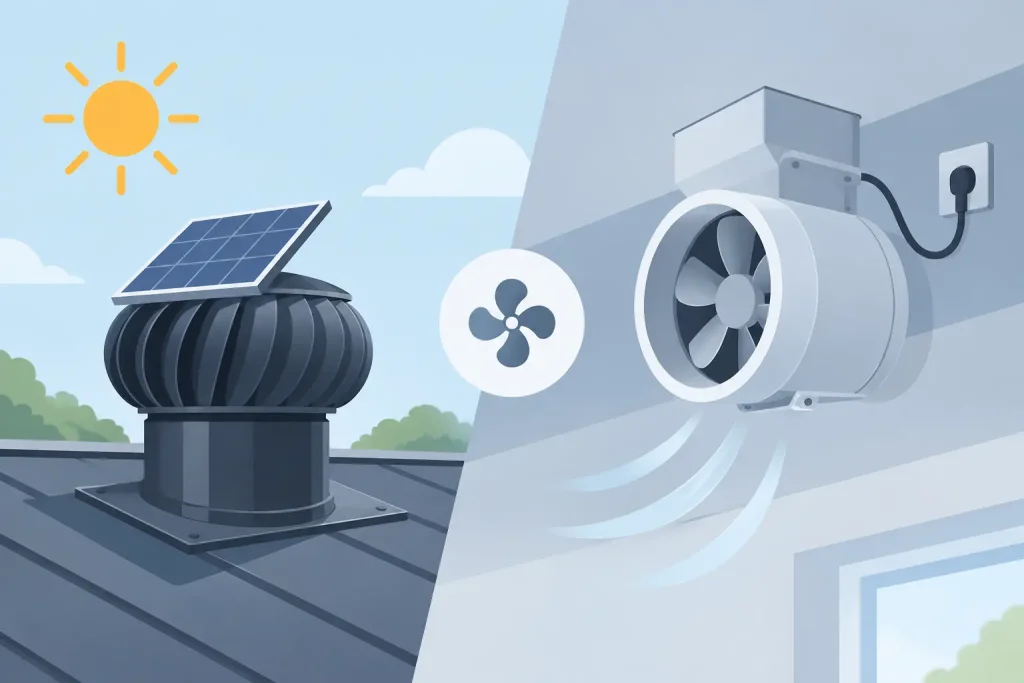
A roof space that traps heat all afternoon can make the rooms below uncomfortable long after sunset. For a homeowner, that often means higher cooling demand. For a warehouse or factory, it can mean poorer working conditions, moisture concerns and excess heat around stored goods. The choice between solar versus electric ventilators affects not only airflow, but installation work, running costs, safety controls and how reliably the system operates at different times of day.
The right answer is not simply the fan with the highest stated capacity. It is the ventilator that suits the roof, the building’s heat load, the available make-up air and the operating environment.
Solar versus electric ventilators: the operating difference
A solar attic ventilator uses a photovoltaic panel to power a DC motor and fan. When sunlight reaches the panel, the fan extracts hot air from the roof space. It requires no TNB connection, no dedicated electrical wiring and no ongoing electricity charge for normal daytime operation. This makes it a practical option for homes, workshops and remote buildings where arranging an electrical supply to the roof would add cost or disruption.
An electric ventilator uses mains electricity to drive the fan. Its main advantage is predictable operation whenever power is available. It can run after dark, during rain or on heavily overcast days, and it can be connected to controls such as timers, thermostats, humidistats or building-management systems. This suits buildings that need scheduled or continuous extraction rather than ventilation that follows daylight conditions.
Both systems are mechanical ventilators, so both have motors and moving fan components. The difference is the power source and the installation requirement. Solar models reduce dependence on cabling and grid power; electric models provide controllable operation independent of sunshine.
When a solar ventilator is the better fit
Solar ventilation is strongest when the heat problem is also a daytime problem. Sun heats the roof covering, attic air temperature rises, and the solar panel produces power at the same period. The operating pattern is naturally aligned.
For residential roofs, a solar attic fan can remove accumulated heat without adding to the electricity bill. It is particularly useful where access for wiring is difficult, where the consumer unit is far from the roof, or where the owner wants a straightforward roof-level installation. A correctly selected unit must still be matched to the roof-space volume and have sufficient intake ventilation at the eaves or soffits. An extractor cannot perform properly if replacement air has nowhere to enter.
For agricultural buildings, small workshops and detached stores, solar ventilation can also avoid the cost of bringing electrical cables across a site. Fewer electrical components can simplify installation planning. However, the panel must have a clear, suitably orientated position with limited shading from nearby buildings, trees, tanks or roof structures.
Solar ventilation has limits that should be considered before purchase. Output will reduce in low light, and standard direct-solar units do not provide the same extraction after sunset as they do at midday. A battery-backed system may extend running time, but it introduces additional equipment, charging considerations and replacement requirements. Where night-time ventilation is essential, mains electric or a passive roof-ventilation design may be more appropriate.
When electric ventilation is the better fit
Electric ventilators suit sites where airflow must be available to a programme, not just to the weather. A production area that operates night shifts, a warehouse with persistent humidity, or an enclosed plant room may need extraction at specified hours and a consistent duty cycle. Mains-powered fans can meet that requirement when correctly designed, installed and protected.
They are also suitable where the required ventilation rate is high and the system needs ductwork, multiple extraction points or automated controls. A facilities manager may need the fan to start when a temperature threshold is reached, operate at reduced speed overnight, or work with other mechanical services. These are areas where electric systems offer greater control.
That control comes with a cost. Electrical installation must be completed to the appropriate standard, including cable routing, isolators, weather protection and safe maintenance access. Electricity consumption must be included in operating costs, particularly where fans run for long hours. Motors, belts where fitted, controls and electrical connections also need an inspection and maintenance plan.
For a straightforward domestic attic heat issue, the extra electrical work can outweigh the benefits of all-hours operation. For an industrial process area, it may be the necessary choice. The building’s duty requirement should decide the system, rather than the assumption that one power source is always superior.
Safety is decisive in hazardous areas
Oil and gas sites, chemical stores and locations with flammable vapours, dusts or combustible materials require a different level of assessment. A general electric roof fan must never be treated as an automatic solution in a hazardous environment. Electrical equipment can introduce ignition concerns unless it is specifically selected, certified and installed for the relevant zone classification.
In these applications, passive updraft ventilators and wind turbine ventilators can offer an important safety advantage. They operate without electrical connections and, in suitable designs, without motors. No spark, no static current and no dependence on grid power are meaningful benefits where ignition prevention is a primary requirement.
Passive systems do not provide the switched, guaranteed output of an electric fan. Their performance depends on stack effect, wind conditions, roof geometry and the available air path through the building. Yet for large industrial roofs, they can provide continuous natural extraction with low operating complexity. The correct approach is to assess the hazard classification, heat source, vapour characteristics, building volume and required air-change rate before choosing any ventilator.
Compare the full installation cost, not only the unit price
A solar unit may cost more than a basic electric fan at the point of purchase, but its installed cost can be lower where there is no nearby electrical supply. There is no need for a new circuit, long cable run or electrical connection to the roof. Over time, daytime operating energy is supplied by the panel.
An electric ventilator can have a lower equipment price yet require additional labour and materials. The total figure may include wiring, isolators, switches, controls, circuit protection and future electricity use. On the other hand, if the site already has suitable power and requires overnight extraction, that installation cost may be justified.
Material selection matters as much as the power source. Aluminium components are commonly valued for corrosion resistance and low weight on the roof. Industrial buyers should also consider the environment around the building: coastal air, chemical exposure, high humidity, airborne dust and roof-sheet compatibility can all affect the suitable material and finish.
Airflow capacity only works with a complete roof design
A ventilator cannot remove more air than the building can replace. If intake vents are undersized or blocked, extraction performance falls and the fan may draw air through unwanted gaps. This can increase noise, create pressure imbalances and reduce the intended cooling effect.
Before specifying a unit, measure the attic, warehouse or production space and identify where heat, moisture or fumes collect. Consider roof slope, available installation area, ridge and eave details, structural members, waterproofing method and access for installation. For factories and warehouses, also account for roller shutters, louvres, doors, wall vents and process equipment that affect the air path.
Multiple correctly positioned ventilators are often better than one oversized unit. They can distribute extraction across a large roof, reduce stagnant hot zones and provide a more practical installation arrangement. Capacity figures should be reviewed alongside the actual duty conditions, not treated as a stand-alone buying decision.
A practical choice for each building type
For a house with a hot attic and no need for night-time extraction, solar is usually the simpler operating choice. It targets the hottest daylight hours, avoids TNB connection and keeps ongoing energy use low.
For a commercial building that needs controlled airflow after dark or in all weather, electric ventilation may be justified. Specify controls and maintenance access from the start, rather than adding them after installation.
For large roofs and sensitive industrial environments, passive updraft or turbine ventilation deserves serious consideration. The absence of wiring, motors and electrical ignition sources can be more valuable than automated fan control. Forest Wind Corporation manufactures solar, turbine and passive roof ventilators in configurations suited to residential and industrial roof applications.
A good ventilation decision starts on the roof, not in a catalogue. Confirm the building use, heat and moisture source, required operating hours, intake-air provision and site safety conditions. With those details clear, the most suitable ventilator becomes a practical engineering choice rather than a guess.