
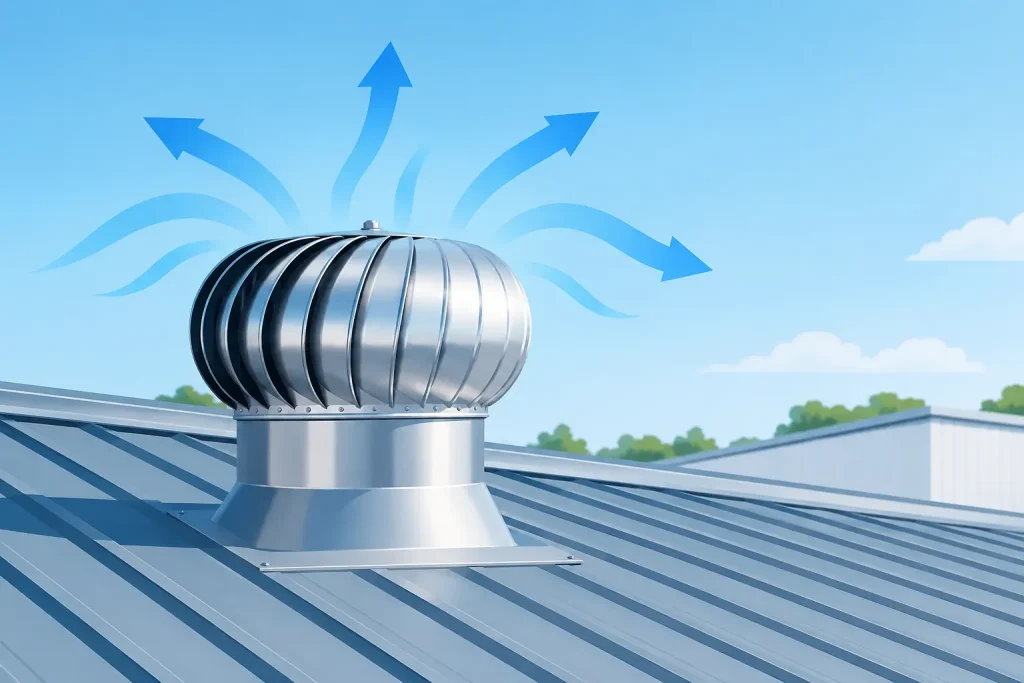
A roof turbine that looks correctly sized can still underperform if its airflow rating does not match the building. Turbine ventilator capacity is the practical measure that determines whether heat, moisture, fumes and trapped air are actually removed from the roof space. For a home, poor capacity can mean a hotter ceiling and damp insulation. For a factory or warehouse, it can affect worker comfort, stored goods and operating safety.
The right answer is not simply to install the largest ventilator available. Capacity must suit the roof area, internal volume, heat load, roof design and air-intake provision. A well-planned passive system works continuously without motors, wiring or grid electricity, but it must be sized and positioned as a complete ventilation system.
What turbine ventilator capacity means
Turbine ventilator capacity refers to the volume of air a unit can extract over a given period, commonly stated in cubic feet per minute or cubic metres per hour. The actual result on site is affected by wind speed, temperature difference between indoor and outdoor air, turbine diameter, throat design and roof installation.
A wind turbine ventilator rotates when wind passes through its blades. This creates negative pressure beneath the unit and draws rising hot air out through the roof. Even in light wind conditions, warm air naturally rises and supports the updraft effect. There is no motor to burn out, no wiring to install and no electricity bill for operation.
However, a catalogue airflow figure should not be treated as a guaranteed result in every location. A high wind-speed rating may look impressive, but a sheltered roof, nearby taller buildings or an enclosed roof void may produce different operating conditions. Capacity should always be considered alongside the building and its exposure.
Calculating turbine ventilator capacity by application
The starting point is the space that needs ventilation. Residential attic ventilation is usually based on roof or ceiling area, while industrial ventilation also requires attention to building volume, process heat, humidity, airborne contaminants and occupancy.
Homes, attics and residential roofs
A roof space accumulates solar heat quickly, particularly beneath dark roof coverings or where insulation restricts the escape of warm air. The purpose of a turbine ventilator is to remove this hot air before it transfers through the ceiling into occupied rooms.
Measure the roof or attic floor area, then consider the roof pitch, available intake openings and local exposure to wind. A larger detached house may need more than one turbine to distribute extraction across the roof, rather than relying on a single unit at one end. Long roof plans, separate attic sections and internal roof obstructions can also require additional units.
Intake air is essential. Exhausting air through turbines without adequate soffit, eave or wall vents restricts the system. The turbine cannot remove air that cannot enter the roof void. A balanced design uses lower-level aluminium air vents or other suitable intake openings to replace the warm air being extracted.
Factories and warehouses
For a factory, warehouse or workshop, the roof area alone is rarely enough to determine capacity. High ceilings increase air volume, while machinery, ovens, production lines, forklifts and solar gain can create continuous heat loads. A warehouse holding sensitive stock may also need humidity control through steady air exchange.
Divide large roofs into ventilation zones. This is more effective than concentrating all turbine ventilators in one location. Units should be placed near the highest points of the roof where hot air gathers, while allowing for structural members, skylights, ridge details and maintenance access.
Capacity selection must also account for the work being carried out below. General heat extraction is one application. Localised fumes, welding smoke, chemical vapours or dust may require dedicated extraction equipment, filtration or a formally engineered ventilation design. A roof turbine is highly effective for general passive ventilation, but it is not a substitute for process-specific controls where regulations or hazardous substances demand them.
Oil, gas and chemical-storage environments
In hazardous locations, ventilation equipment must be chosen with ignition prevention in mind. Electrical fans introduce motors, wiring and potential maintenance requirements. Passive turbine and non-motorised updraft ventilators provide a useful alternative where the application permits, because they operate without electrical connection.
No Wiring, No Maintenance, No TNB Connection Required. More importantly for sensitive sites, a properly specified non-electrical ventilator does not rely on a motor that may create sparking risk. Material selection, earthing requirements, site classification and chemical compatibility must still be reviewed by the project team. Capacity matters, but safety suitability comes first.
Factors that change real airflow
A ventilator diameter is an important specification, but it is only one part of capacity. Larger throat sizes can generally move more air, yet the correct choice depends on the demand across the whole roof. A number of conditions influence real performance:
- Wind exposure: Open industrial estates and coastal locations may provide stronger driving wind than built-up residential areas.
- Roof height and pitch: Higher roofs and suitably positioned units can improve access to rising heat and moving air.
- Internal heat gain: Metal roofs, direct sun, machinery and warm processes increase the amount of air that needs removing.
- Air intake area: Restricted intake vents reduce exhaust performance and can create unwanted negative pressure.
- Obstructions: Partition walls, insulated ceilings, storage racks and roof framing can stop hot air from reaching the ventilator.
- Material and construction: Aluminium, galvanised steel and stainless steel options should be selected for corrosion exposure, roof type and site environment.
For this reason, capacity should be discussed in terms of required system performance, not just the airflow of one turbine. Two correctly located medium-size ventilators can perform better than one large unit serving a complex roof void.
Selecting the right turbine size and quantity
Start with accurate dimensions. Record the length and width of the roof section, ceiling height or roof-void depth, roof slope and the areas served by each section. For industrial buildings, identify heat-producing equipment, operating hours, doors that remain open, stored materials and any areas where fumes may accumulate.
Next, select a ventilator size designed for the roof and environment. Smaller turbine ventilators may suit compact residential roofs, while larger-diameter units are generally more appropriate for warehouses, factories and high-volume spaces. Material choice matters as much as size on corrosive, coastal or chemical-exposure sites.
The quantity should then be distributed to suit the airflow path. Turbines installed along a ridge or high roof line can extract heat more evenly than units clustered together. Keep them clear of areas where air cannot reach them, and coordinate the layout with roof trusses, gutters, skylights and solar equipment.
A direct product specification and quote review is useful where the roof is large, unusual or safety-critical. Providing roof dimensions, photographs, roof material, pitch and application details allows the required capacity to be assessed against suitable turbine sizes and passive air-vent options.
Avoid common capacity mistakes
The most common mistake is selecting a turbine based on price alone. A low-cost unit that is undersized, poorly installed or made from unsuitable material can leave the same heat problem unresolved. It may also add avoidable roof work later when more units are needed.
Another mistake is overlooking make-up air. If eaves are sealed, intake vents are blocked by insulation or wall openings are inadequate, the ventilation system has no balanced airflow path. Roof extraction and fresh-air entry must work together.
Do not assume that turbines will solve every air-quality issue. They are excellent for removing accumulated heat and stale rising air from roof spaces, factories and warehouses. Where contaminants are generated at source, local extraction and site-specific safety controls may be required alongside general roof ventilation.
A practical approach to capacity planning
Forest Wind has manufactured roof ventilation systems since 1989 for residential and industrial applications. The practical objective is straightforward: choose a turbine ventilator capacity that removes the expected heat load, fits the roof correctly and has sufficient intake air to operate efficiently over the long term.
Before ordering, prepare the roof dimensions, building use, preferred material, roof slope and any safety constraints. Those details turn a general ventilation question into a specification that can protect comfort, roof performance and workplace conditions for years to come.