
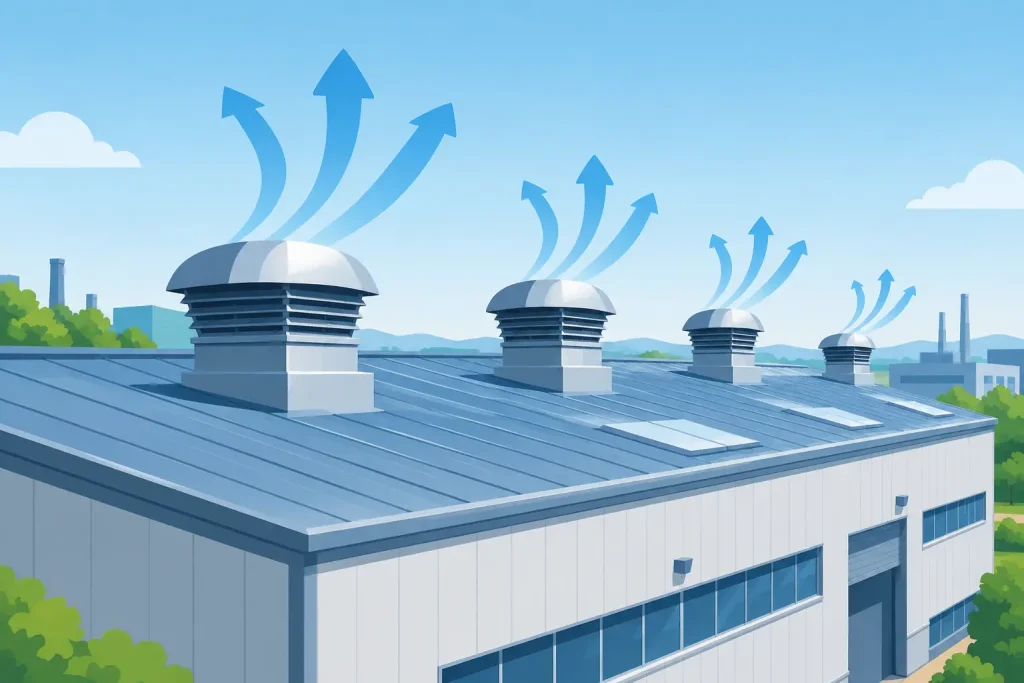
A factory roof can hold far more heat than the working area below suggests. Solar gain, process heat, warm machinery and rising vapour collect at the highest point of the building, where they can remain trapped unless there is a clear escape route. Effective factory roof ventilation removes this hot, stale air at source, helping protect people, stock, equipment and the roof structure itself.
For a facilities manager, the issue is rarely just comfort. Excess heat can affect concentration, increase strain on cooling equipment and create uncomfortable conditions at production lines. In warehouses, condensation may damage cartons, stored materials and steel racking. At oil and gas sites or chemical-storage facilities, ventilation is also part of a wider safety strategy: the system must support air movement without introducing avoidable ignition risks.
What factory roof ventilation needs to achieve
A roof ventilator works with a simple physical fact: warm air rises. As it gathers beneath the roof, an extractor installed high on the roof allows it to leave the building. Replacement air then enters through correctly planned lower-level louvres, wall vents, doors or other inlet openings. This creates continuous upward airflow rather than simply moving hot air around inside the factory.
The best result comes from balancing extraction and intake. Installing powerful roof units without sufficient incoming air can reduce performance, increase draughts at openings and leave stagnant areas across the floor. Equally, adding wall openings alone does not reliably clear the hottest air trapped at ridge level.
A practical factory ventilation design should address four operating needs:
- heat removal from roof voids and production spaces;
- extraction of moisture, vapour, fumes or odours where applicable;
- adequate fresh-air entry at low level; and
- safe operation in the actual conditions of the site.
The last point matters most in higher-risk environments. A ventilator selected for an ordinary warehouse may not be suitable for a site handling flammable vapours, corrosive chemicals or combustible dust. Airflow capacity is only one part of the specification.
Passive, turbine and solar options
There is no single ventilator type for every factory roof. Roof height, building volume, heat load, wind exposure, roof profile and site risk all affect the correct choice.
Non-motorised updraft ventilators
Passive updraft ventilators use the natural buoyancy of hot air. With no motor, wiring or grid connection, they offer a straightforward way to exhaust heat continuously from workshops, warehouses and industrial buildings. They are particularly useful where a large roof area needs multiple extraction points and where long-term operating simplicity is a priority.
Their performance depends on the temperature difference between inside and outside, the available inlet air and the design of the roof system. They are not a substitute for mechanical extraction where a process creates a controlled contaminant load that must be captured at source. However, for general heat removal and day-to-day air change, they can provide dependable ventilation with no electrical running cost.
Wind turbine ventilators
Wind turbine ventilators use wind energy to create extraction at the roof. They can increase air removal when outdoor wind conditions are favourable while also supporting natural upward airflow. They are commonly considered for factories, warehouses and agricultural or light-industrial buildings where heat build-up is a regular problem.
Material selection is important. Aluminium construction provides low weight and corrosion resistance for many roof applications, while heavier-duty material choices may be appropriate for more demanding environments. The ventilator base, flashing arrangement and fixing method must match the roof profile and slope. A correctly sized turbine fitted poorly will not deliver its intended performance or weather protection.
Solar-powered roof ventilators
Solar-powered ventilators use daylight to run an electric fan without a mains supply. They are useful where natural stack effect alone is insufficient during hot, still conditions, especially on roofs exposed to strong sun. As solar intensity rises, the fan can provide additional extraction when internal heat gain is also at its highest.
This option avoids routine grid wiring and can reduce dependence on conventional powered extraction. It does, however, require clear consideration of panel placement, shading, fan capacity and the hours when ventilation is required. If a process runs through the night or creates fumes that need continuous controlled extraction, a solar unit may need to sit within a broader ventilation plan rather than operate as the only solution.
Sizing a roof ventilation system correctly
Choosing by roof area alone is a common mistake. Two factories with the same footprint can require very different ventilation because their roof heights, insulation levels and internal heat sources differ.
Start with the building volume, not just square metres. A high-bay warehouse contains a much larger air volume than a low workshop of the same floor size. Then consider where heat is generated. Ovens, compressors, furnaces, vehicle charging areas, production machinery and direct solar exposure can all add heat that needs to be released.
The planned location of each roof ventilator is equally important. Units should be distributed to serve the full roof area, with attention given to the hottest zones and places where air is likely to stagnate. A line of ventilators close to the ridge often makes sense on pitched roofs because that is where hot air accumulates. On larger or more complex roofs, separate zones may be needed rather than relying on one extraction point.
Intake provision should be reviewed at the same time. Aluminium air vents, wall louvres and other low-level openings allow replacement air to enter. Without this path, the extraction system has less air to draw from. Inlet air should be arranged so it supports circulation through occupied and working areas without directing unwanted rain, dust or excessive draughts towards sensitive processes.
For quotation and specification purposes, prepare the roof dimensions, ridge height, roof pitch, roof material, internal layout, operating temperature, process details and any hazardous-area requirements. Clear site information makes it possible to select ventilator size, quantity and mounting arrangement with fewer assumptions.
Safety decisions for hazardous and corrosive sites
Oil and gas facilities, chemical stores and similar locations need a more cautious approach than general factory buildings. Where flammable gases or vapours may be present, electrically driven equipment can create additional design questions around sparks, wiring and static current. Passive ventilation systems offer a direct advantage here because they operate without motors or electrical connection.
No Spark, No Static Current is a meaningful operating benefit when the equipment is appropriate for the site and installed as part of the facility’s safety controls. It does not remove the need for a proper risk assessment, local regulations, source control or specialist engineering advice. Ventilation must be matched to the substances handled, likely vapour release points and required air-change or extraction standards.
Corrosion also deserves attention. Chemical exposure, coastal air and humid production conditions can shorten the life of unsuitable roof equipment. Specify materials and finishes for the actual environment, not simply for the lowest initial price. A ventilator that resists corrosion and remains securely fixed is usually the better long-term purchase.
Installation details that affect performance
Roof ventilation is not only about the ventilator body. The roof curb or base must fit the sheet profile, roof slope and structural arrangement. Flashing must be sealed correctly to prevent water ingress, and fixing points must withstand local wind loading. On older roofs, assess the condition of roof sheets and supporting members before adding equipment.
Avoid placing units where they will discharge directly into neighbouring air intakes or draw contaminants across office areas. Consider maintenance access too, even where the ventilator itself has no motor and minimal servicing needs. Roof-safe access supports inspection of flashings, fixings, bird guards and surrounding roof condition.
For passive and turbine systems, the operational message is simple: No Wiring, No Maintenance, No Mains Connection Required. In practice, periodic roof inspection is still sensible. Leaves, packaging film, nesting material and storm damage can obstruct airflow or affect weather sealing over time.
Selecting a system built for the roof and the risk
The lowest-cost ventilator is not automatically the lowest-cost installation over its service life. Electricity use, wiring work, access constraints, maintenance demand, corrosion resistance and replacement downtime all belong in the decision. Passive, turbine and solar options each have a place when selected for the right duty.
Forest Wind has manufactured roof ventilation systems since 1989 for residential roofs, factories, warehouses and industrial sites. The practical starting point is not a generic product choice but a clear view of the building, the heat source and the safety requirement. Provide accurate roof and operating details, then specify ventilation that gives hot air a reliable route out of the building.