
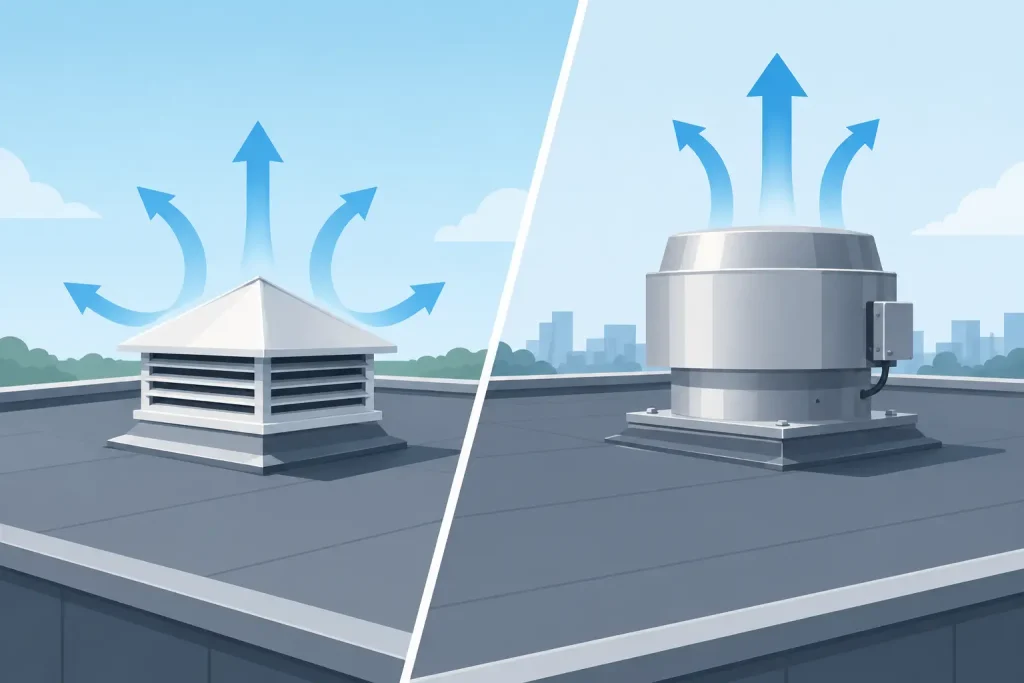
A roof space that traps heat, moisture, fumes or stale air will affect far more than indoor comfort. It can increase cooling demand, strain stored materials, shorten roof-life components and create avoidable workplace risk. The choice between passive versus powered extraction determines how that air leaves the building, what the system costs to operate and how it performs when conditions change.
For homes, the priority may be a cooler attic and reduced condensation. For a warehouse or factory, the decision can involve high roof volumes, process heat, shift patterns and safe ventilation around sensitive operations. There is no single correct answer. The right extraction method depends on the building, the source of heat or contaminants, the available make-up air and the level of control required.
How passive extraction works
Passive extraction uses natural forces rather than an electric motor. Warm air rises, creating an updraft through a roof ventilator. Wind passing over the roof can also create a pressure difference that helps draw indoor air upwards and out. Non-motorised updraft ventilators use this stack effect, while wind turbine ventilators use wind energy to increase extraction.
The immediate advantage is operating simplicity. There is no TNB connection, no wiring and no motor-driven electricity consumption. A correctly selected passive roof ventilator can operate continuously without adding to the building’s electrical load. This makes passive systems particularly practical for roofs where electrical access is difficult, expensive or undesirable.
Passive extraction is also relevant where electrical equipment at roof level creates an unnecessary concern. In oil and gas sites, chemical-storage areas and other environments with flammable vapours, the ventilation strategy must be designed around the site hazard assessment and applicable safety requirements. A non-electrical ventilator has no electrical spark or static-current source at the extraction point. However, passive ventilation alone is not a substitute for a full hazardous-area design, gas detection or required mechanical controls.
Performance is tied to conditions. Hot internal air supports natural updraft, and wind supports turbine action, but neither force is fully constant. A cool, still day will not produce the same extraction rate as a hot, windy afternoon. Passive systems therefore work best when the roof area, ventilator quantity, opening size and air-inlet provision are calculated for the building rather than chosen by appearance alone.
How powered extraction works
Powered extraction uses a fan and motor to move air at a more predictable rate. Mains-powered roof fans can be specified for scheduled operation, thermostatic control or connection to a wider building ventilation system. Solar attic ventilators use solar energy to power the fan, offering active extraction without dependence on grid electricity or roof wiring to the supply.
The main benefit is controlled airflow. Where a factory generates heat throughout the day, where occupancy changes rapidly or where a specific extraction volume is required, a powered unit can provide capacity that natural forces may not consistently achieve. It can also be useful in low-rise buildings, enclosed roof voids or sheltered locations with limited wind exposure.
Powered extraction has its own requirements. Motors, blades, electrical connections and controls need suitable specification, installation and periodic inspection. Mains-powered equipment adds electrical infrastructure and running costs. Solar-powered units remove the grid connection but still rely on adequate solar exposure and have motorised components. Their output will naturally reduce when sunlight is weak, which should be considered for night-time operations or consistently shaded roofs.
For hazardous locations, do not assume that any powered fan is suitable. The motor, control equipment and electrical installation must be selected for the site classification where required. In many cases, a passive solution is preferred because it avoids an electrical ignition source at the ventilator, but the final decision should follow the facility’s safety engineering requirements.
Passive versus powered extraction: the practical differences
The first question is not whether a fan is better than a passive ventilator. It is whether the building needs variable natural extraction or defined mechanical airflow.
Passive systems are usually stronger on long-term operating simplicity. They do not use purchased electricity and, depending on the design, may have minimal service requirements. They suit naturally hot roof spaces, agricultural buildings, warehouses with good natural air paths, and industrial roofs where continuous background heat release is needed without electrical dependence.
Powered systems are stronger where extraction must be more measurable and responsive. They are appropriate when internal heat gains are high, roof voids are heavily enclosed, work areas require a more consistent environment, or operations need extraction at specific times. A solar attic fan can be a useful middle option for residential roofs and light commercial buildings where daytime attic heat is the principal issue.
Neither system can extract air effectively if replacement air cannot enter. A roof ventilator pulls air out, but lower-level wall vents, eave vents, louvres or other planned intake openings allow fresh air to replace it. Without make-up air, the pressure difference falls and extraction capacity is restricted. This is one of the most common reasons a ventilation installation underperforms.
Selecting by building type
Residential roofs
Homes often need to control attic heat and moisture without adding complicated electrical work. Passive updraft ventilators are a dependable option for ventilation throughout the day and night, particularly on roofs with good sun exposure that build heat naturally. Wind turbine ventilators can provide additional extraction where local wind conditions support them.
Solar attic ventilators are suitable when the homeowner wants active daytime heat removal without a TNB connection. They can help reduce heat accumulation beneath metal or tiled roofs during sunny periods. The choice should account for attic volume, roof orientation, shading, ceiling insulation and existing inlet vents. A fan cannot correct missing insulation, roof leaks or blocked soffit ventilation.
Warehouses and factories
Large roofs need a more deliberate calculation. Building volume, roof height, stored goods, internal machinery, heat load and worker locations all affect the required ventilation approach. Passive industrial ventilators can provide broad, continuous extraction over large roof areas with no running electricity cost. They are especially useful where heat naturally rises towards the roof and the building has adequate wall or louvre openings for incoming air.
Powered extraction may be necessary when heat is concentrated, production patterns vary, or air movement needs to meet a defined operational target. In some facilities, the effective answer is a combined design: passive roof ventilation for continuous background relief, supported by powered extraction at specific hot zones or process areas. This avoids using motorised capacity where natural ventilation can do the work.
High-risk industrial sites
Oil and gas operations, chemical warehouses and storage facilities require an engineering-led review of vapours, ignition risks, corrosion exposure and emergency procedures. Material selection matters as much as airflow. Aluminium, galvanised steel and stainless steel options should be considered against the environmental conditions, roof structure and expected service life.
A passive ventilator offers a clear operational advantage where avoiding electrical components at roof level is desirable: no wiring, no motor and no electrical spark source. Yet the ventilator size, neck diameter, weather protection, roof-slope compatibility and installation sealing must still be correctly specified. Safety depends on the complete system, not one product feature.
Capacity, materials and installation determine results
A ventilator’s advertised size is not enough to judge suitability. Buyers should assess the effective throat area, extraction capacity under stated conditions, quantity of units required, roof pitch, roof-sheet profile and spacing across the roof. One undersized unit placed at the highest point may look correct but leave distant areas stagnant.
Placement should follow heat and air movement. Roof ventilators are generally positioned near high points where rising hot air collects, while intake openings should be lower and distributed to prevent one-sided airflow. In industrial roofs, repeated units across the building often perform better than concentrating all extraction in one location. This creates a more even path for heat to rise and escape.
Weather resistance also deserves attention. Flashing and base design must match the roofing material, and installation should preserve roof waterproofing. For coastal, humid or chemically exposed environments, specify materials with corrosion resistance appropriate to the site. A lower initial price is poor value if the ventilator body, fasteners or roof interface deteriorates early.
Forest Wind has manufactured roof ventilation systems since 1989, with passive updraft ventilators, wind turbine ventilators and solar-powered attic ventilators available for different roof applications. The sensible starting point is to provide the roof type, building dimensions, internal heat source, required application and any site safety constraints before selecting a model or requesting a quotation.
Choose the extraction method around the real operating condition
Choose passive extraction when continuous natural heat release, no electrical dependence and low operating complexity are the priority. Choose powered extraction when airflow must be more consistent, controllable or responsive to a known load. Choose a combined approach when a large building has both general roof heat and localised high-demand areas.
The best roof ventilation decision begins with one practical question: where will replacement air enter after hot air leaves? Once that airflow path is clear, the correct capacity, ventilator type and installation layout become much easier to specify.