
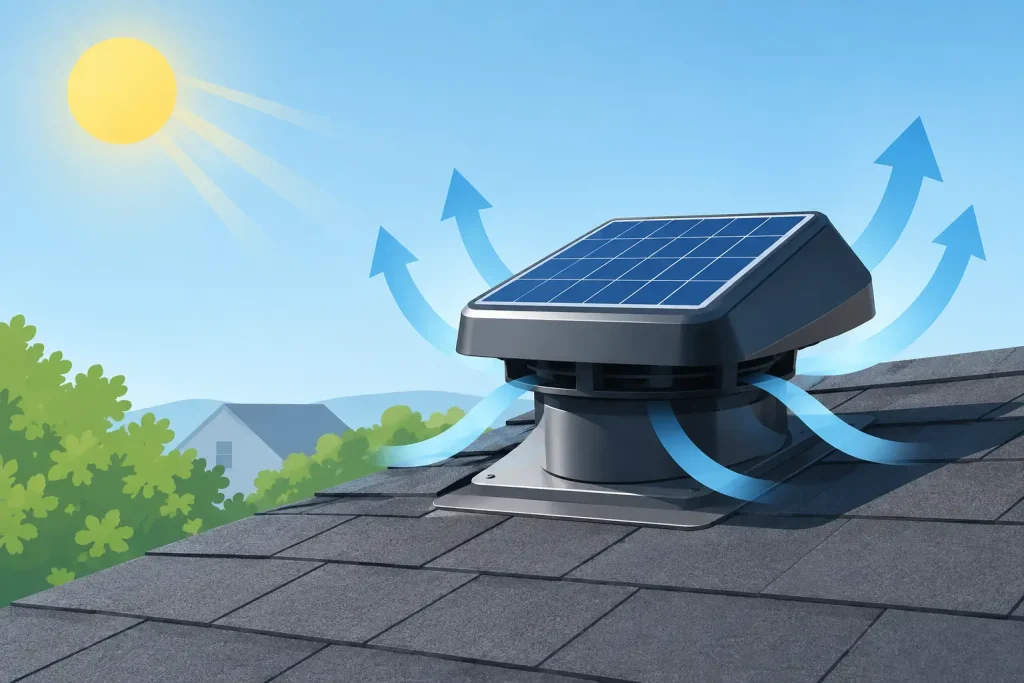
A roof ventilator fan solar system earns its place when roof-space heat is the real problem and running electrical wiring is costly, impractical or undesirable. On a sun-exposed roof, the panel powers the fan directly, drawing hot air from the attic or upper roof void while daylight is strongest. That is usually the same period when trapped heat places the greatest load on rooms below.
For homeowners, this can mean a less oppressive upper floor and reduced dependence on air conditioning. For builders and facility teams, it provides a way to ventilate suitable roof spaces without a TNB connection, electrical cabling or ongoing electricity use. The right choice, however, depends on the building volume, roof construction, intake-air provision and the duty required from the ventilator.
How a roof ventilator fan solar system works
A solar attic ventilator combines a roof-mounted solar panel with a DC fan. Sunlight produces the energy needed to turn the fan, and the fan extracts heated air from beneath the roof. As hot air leaves, cooler replacement air is drawn into the roof space through correctly positioned intake vents, such as soffit or eave vents.
The principle is straightforward: hot air rises, but it must have a clear route out. A fan improves extraction during sunny conditions, when roof sheets, tiles and ceiling spaces absorb the most heat. No Wiring, No TNB Connection Required is not simply a convenience claim. It can reduce installation disruption where a suitable electrical point is distant, inaccessible or would require additional protection work.
A solar fan does have moving parts, unlike a passive updraft ventilator. Its performance therefore depends on panel exposure, fan design and component quality. For many residential attic applications, the active airflow is a useful advantage. For locations that require continuous ventilation regardless of weather, a passive ventilator or wind turbine may be the better primary option.
Where solar roof fans make practical sense
Solar-powered extraction is most effective on roofs receiving reliable daylight, with a defined enclosed space below the roof covering. Typical applications include detached houses, upper-storey roof voids, workshops, small commercial buildings and guard houses. It is particularly useful where the top floor becomes noticeably hotter in the afternoon, even when the occupied rooms are air conditioned.
In these cases, the fan is not designed to cool a room directly. It removes heat from the roof void before that heat transfers through insulation and ceilings. Results vary with insulation quality, ceiling gaps, glazing, roof colour, local climate and how much outside air can enter the roof space. A solar fan should be considered one part of heat management, not a substitute for insulation or a correctly sized air conditioning system.
For a warehouse or factory, scale changes the decision. A small attic fan is unlikely to manage the heat load of a large production floor, high-bay warehouse or metal-roofed industrial building. These sites often need high-capacity roof ventilation, using multiple passive updraft ventilators or turbine ventilators sized around the building volume, internal heat sources and roof layout.
In oil and gas facilities, chemical-storage areas and other hazardous environments, safety takes priority over convenience. Electrical motors can introduce concerns around sparks, static current and ignition sources. Non-motorised roof ventilators are often the more suitable route because they provide airflow without electrical connection. No Spark, No Static Current is a critical operational benefit where flammable vapours or hazardous substances may be present. Site-specific engineering and safety requirements should always govern final product selection.
Choosing the right roof ventilator fan solar capacity
Do not select a solar roof fan on panel size or appearance alone. The fan must move enough air for the roof-space volume and heat load. A larger roof void, a long low-pitch roof, or a roof with heavy solar gain may require more than one unit or a different ventilation method.
Start by establishing the length, width and average height of the enclosed roof space. This gives the approximate air volume that needs to be ventilated. Then consider the roof material and building use. A dark metal roof above an uninsulated ceiling will gain heat differently from a tiled, insulated residential roof. A workshop with equipment operating beneath the roof has a different requirement again.
Air intake is equally important. An extractor cannot perform properly if the roof void is sealed. The incoming air should be distributed through eaves, soffits or other low-level intake points so that air travels across the roof space rather than being pulled from one nearby gap. Inadequate intake can reduce airflow, create unwanted negative pressure and make the fan work harder for little benefit.
The practical checks below should be completed before ordering:
- Confirm the internal roof-space volume and whether the intended unit is rated for that application.
- Check that eave or soffit vents provide sufficient replacement air.
- Measure roof pitch, available mounting area and distance from obstructions that may shade the solar panel.
- Identify the roof covering and select suitable flashing, base design and corrosion-resistant materials.
- Consider whether ventilation is needed only during sunny heat periods or continuously throughout the day and night.
A contractor should also inspect the roof structure, waterproofing details and access for safe installation. Cutting an opening in a roof is not a place for guesswork. The ventilator must be securely fixed, correctly flashed and positioned to prevent water ingress.
Solar fan, turbine or passive updraft ventilator?
Each system has a clear operating role. A solar roof fan provides active extraction while the panel receives daylight. It suits roofs where daytime heat is the main complaint and a no-grid-power installation is preferred. Because airflow is fan-driven, it can be more predictable than a wind turbine during still, sunny weather.
A wind turbine ventilator uses wind to rotate its head and extract air. It needs no motor or wiring and can operate outside daylight hours when wind is available. It is widely used on houses, workshops and industrial roofs, but output naturally changes with wind conditions. Correct bearing quality, aluminium construction and roof installation matter for long service life.
A non-motorised updraft ventilator uses natural heat rise and pressure differences to release hot air. It has no motor and no moving parts, making it a strong choice for demanding industrial environments and hazardous locations. Large-capacity models can serve factories and warehouses where broad, continuous roof ventilation is required. Their performance depends on design, height, air intake and the temperature difference between inside and outside.
It is not always an either-or decision. A building may use passive vents to provide baseline ventilation and solar-powered fans in selected hot roof zones. The design should follow the building’s operational need, not a one-product approach.
Materials and roof compatibility matter
Roof ventilators live in harsh conditions: ultraviolet exposure, heavy rain, wind uplift, heat cycling and airborne contaminants. Material selection should reflect the environment. Aluminium is valued for its light weight and corrosion resistance, while other material options may be selected for specific roof types or industrial conditions.
For coastal sites, chemical environments or roofs exposed to process emissions, ask for confirmation that the ventilator material and fixings are suitable. The same care applies to roof pitch. A base designed for one roof profile may not sit correctly on another, and poor fitment can create leaks or reduce extraction efficiency.
Placement also affects results. A ventilator should sit high enough on the roof to release accumulated hot air, while solar panels need an orientation and position that avoid frequent shade from parapets, water tanks, taller buildings or trees. On a complex roof with several ridges or separated voids, one unit may ventilate only one section. Treat each enclosed roof zone as its own airflow path.
Operating cost and maintenance expectations
The principal attraction of a solar fan is low operating cost. Once installed, it uses sunlight rather than purchased electricity during operation. There is no electrical wiring to route through the building and no monthly fan electricity consumption to calculate.
That does not mean zero attention forever. Periodic visual checks are sensible. Inspect the solar panel for heavy dirt, leaves or shading, ensure the roof flashing remains sound, and check that nearby intake vents are not blocked by dust, insulation or bird nesting. A motorised solar fan also requires an appropriately durable fan assembly. Passive systems have fewer service components, which is one reason they are often preferred where reliability and safety must be kept simple.
Forest Wind Corporation has manufactured roof ventilation systems since 1989, with solar attic fans, wind turbine ventilators, non-motorised updraft ventilators and complementary aluminium air vents for residential and industrial roofs. The best product is the one matched to the site, rather than the one with the largest headline claim.
Before requesting a quotation, prepare the roof dimensions, roof covering, pitch, photographs, internal use of the building and any known heat or odour issue. Those details make it possible to assess whether a roof ventilator fan solar installation is the practical answer, or whether a larger passive ventilation arrangement will give safer, more consistent long-term performance.